
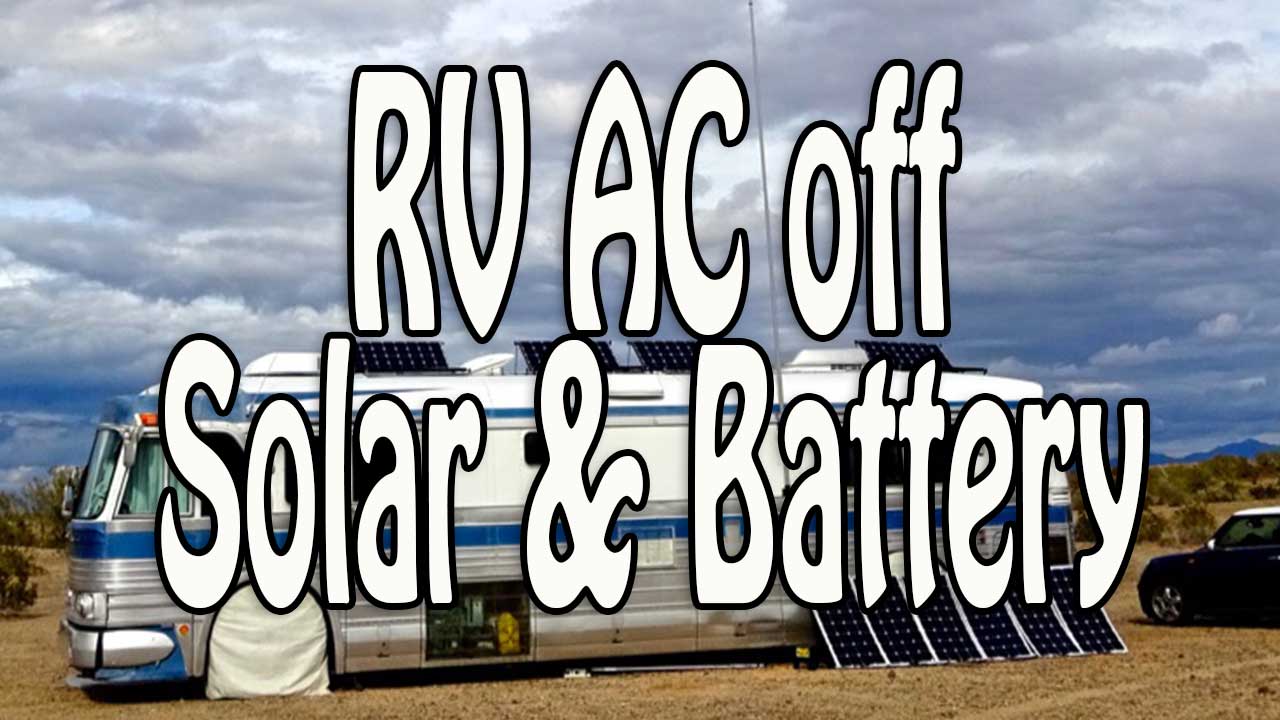
We’re currently driveway surfing with friends in coastal Georgia, where it’s pretty darn hot (and crazy humid!) as the summer fast approaches.
They only have a 15A power outlet on a front porch available for us to plug a long extension cord into, which for many RVs would mean blowing breakers or limping along without being able to run heavy loads like a microwave or an air conditioner.
But making a hot lunch while staying cool is no problem at all for us thanks to the way we have our electrical system setup.
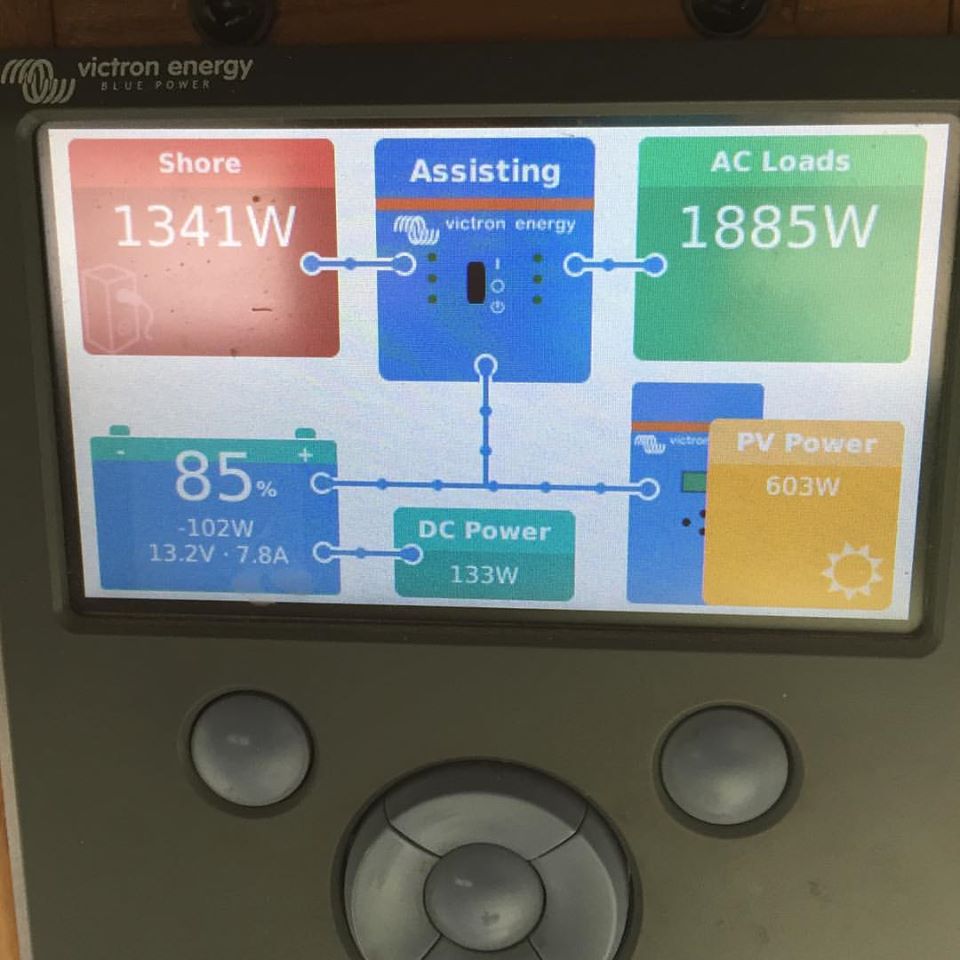
We’ve written about our system before, but as we were watching readings on our Victron CCGX Control Panel showing power combining from the shore, the sun, and our batteries to keep our roof air conditioner cranking along, I told Chris:
We should totally video this!
So we did – and created this little video that shows how all three power sources come together to give us such an incredible amount of flexibility:
Here are some past posts where we’ve talked before about the individual components of our electrical setup:
- Lithium Batteries (500AH at 12v)
- Boosting Hybrid Inverter (Victron MultiPlus 12/3000VA)
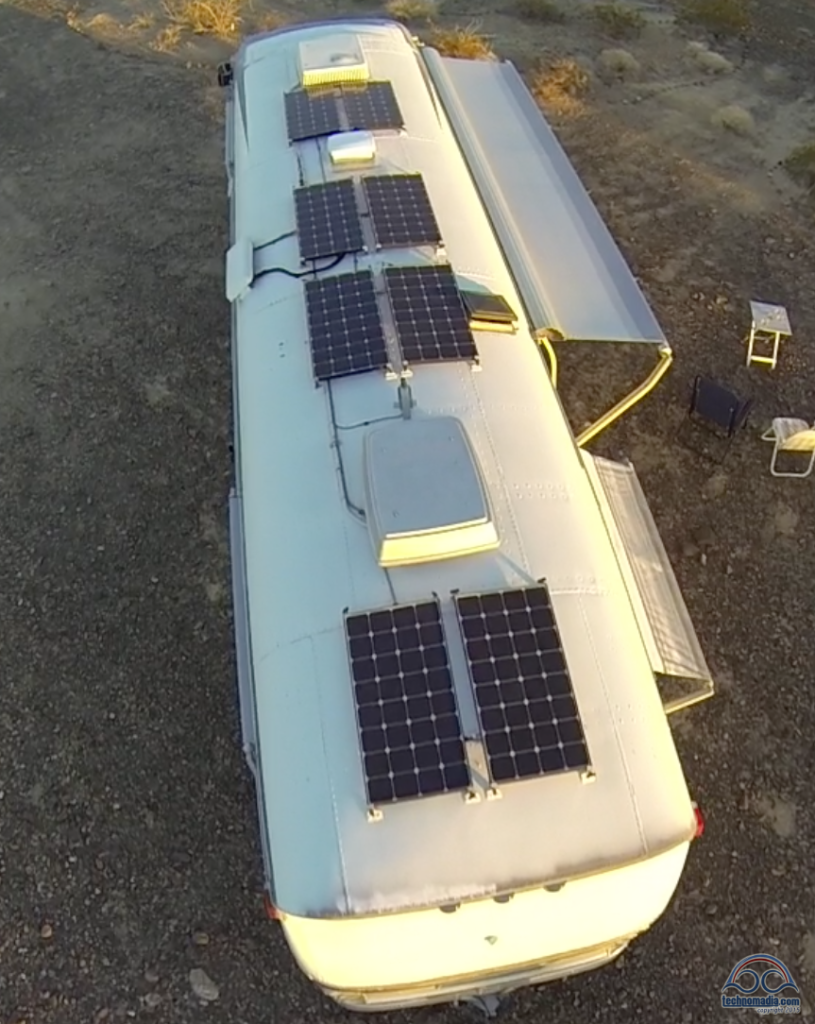
- Solar Setup (800W on the roof, 600W ground deploy)
We’ve been using this setup for nearly 5 years now (the battery & inverter since 2011, the solar added in 2014)… and we have had so many occasions where the increased flexibility has really paid off for us.
A few examples:
- When we endured our 7 week engine rebuild, it enabled us to live onsite in the bus, apprentice during the project, and not melt in the parking lot despite just having a 15A extension cord for power.
- We’ve been able to frequently optimize our view by pulling straight in and using a long extension cord instead of our thick short 50A shore power cord, and even still we can use both ACs during the heat of the day.
- And of course, when it’s not ridiculously hot out, we enjoy a great deal of off-grid camping while being abundantly self contained with our huge tanks and ample solar setup.
Why Not Solar AC?!?
We do get asked all the time about going all-in to run our air conditioners entirely off of solar.
And, well, it is possible.
But it requires a LOT more solar than most people realize, and it is not at all easy to fit that much solar onto an RV roof.
In our case, it would actually be impossible to fit anywhere close to enough solar on the roof without removing (or building over) the roof air conditioners entirely, which kind of defeats the point.
Instead – we consciously decided to optimize our setup for running our air conditioning entirely off battery power, with solar as a supplement.
We can run our AC full blast for 2-2.5 hours, powered only by our 500AH LFP batteries. Whatever sun power we do collect of course extends that run time out significantly.
But if the heat is too extreme to need the AC for more than an hour or two a day – it’s time to retreat to electrical hook-ups, or resort to our 2500w propane-powered generator to supplement the peak demand.
Running an AC this way depletes the batteries, power we also need to run our 12v powered Vitrifrigo marine fridge, computers, lights and cooking (our primary cooking devices are all electric: a single induction stovetop, InstaPot pressure cooker, microwave/convection oven and rice cooker).
Power that has to be restored from somewhere, and at the end of sunny hot day when we might be able to turn off the AC – there’s not much sun left to top up the batteries.
Flexibility Is Key
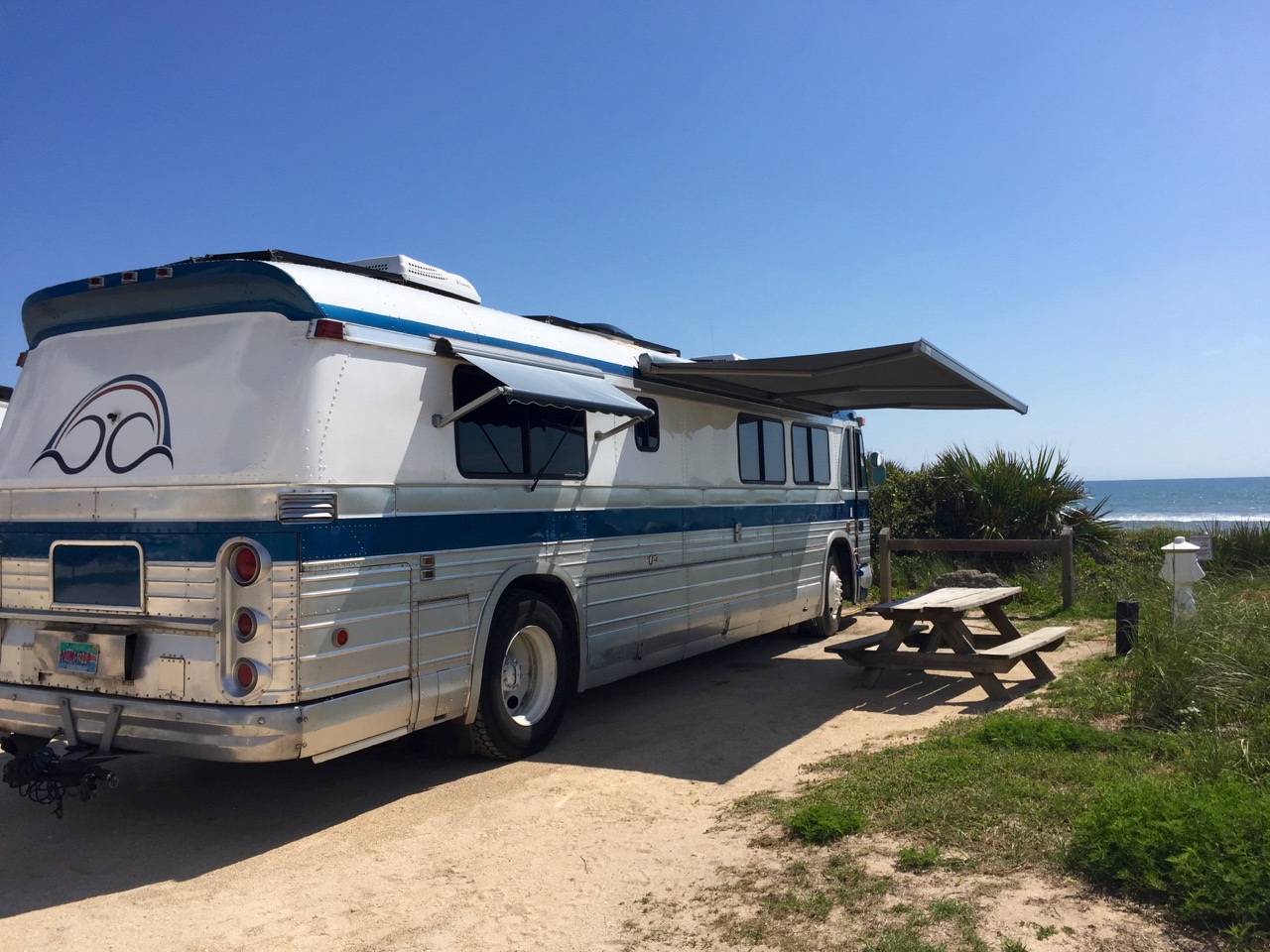
Our setup has always been about optimizing flexibility. We enjoy stays in public parks, boondocking in the wilds, on friend’s land, and even the occasional full hook-up parks.
The ability to run our AC off batteries was initially designed so we could make stops on driving days and keep the RV cool for Kiki while we attended to errands or touristy things.
Our general rule of thumb – if it’s hot enough for regular AC, it’s really time to be seeking cooler temperatures.
After all, that’s why our house has wheels.
If it’s hot enough to need regular air conditioning, then our quality of life is diminishing all around. We’re spending too much time indoors trying to keep cool, and not enough time outdoors doing the stuff we love.
And honestly, we just can’t imagine too many scenarios where we would HAVE to endure extended warm temperatures and not have access to at least enough shore power to supplement the solar.
Maybe one day solar panels will be more efficient, or we’ll increase our battery bank size. That would give us even more capability and flexibility.
But until then, we’ve been extremely happy with our setup.
Before You Ask…
We’ve already had some questions asked over and over in response to this YouTube video, and it has only been up for a few hours. So before you ask…
- Why don’t you use more powerful solar panels? – There are more powerful solar panels to be had, but they are proportionally physically larger. With our curved roof layout, larger panels would not have worked.Our GS-100 panels are small (about 40″ x 20″ each), but they are actually some of the most efficient panels produced. Our panels use Sunpower cells and have an overall module efficiency of 18.3%. That is just about the best you can get from mass produced panels, though Sunpower was able to bring a 20% and 21% version to market in a large form factor for buildings.The world record module efficiency in a lab was recently pushed to 22.8% and then just this March to 23.8%. But those modules are still far from being commercially available.
So… No – there is nothing even in a lab right now that would significantly increase our power production in the same space. If it existed, we’d be all over buying it.
-
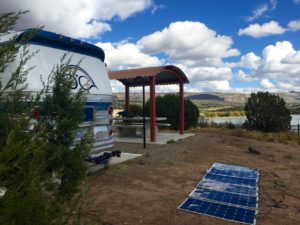
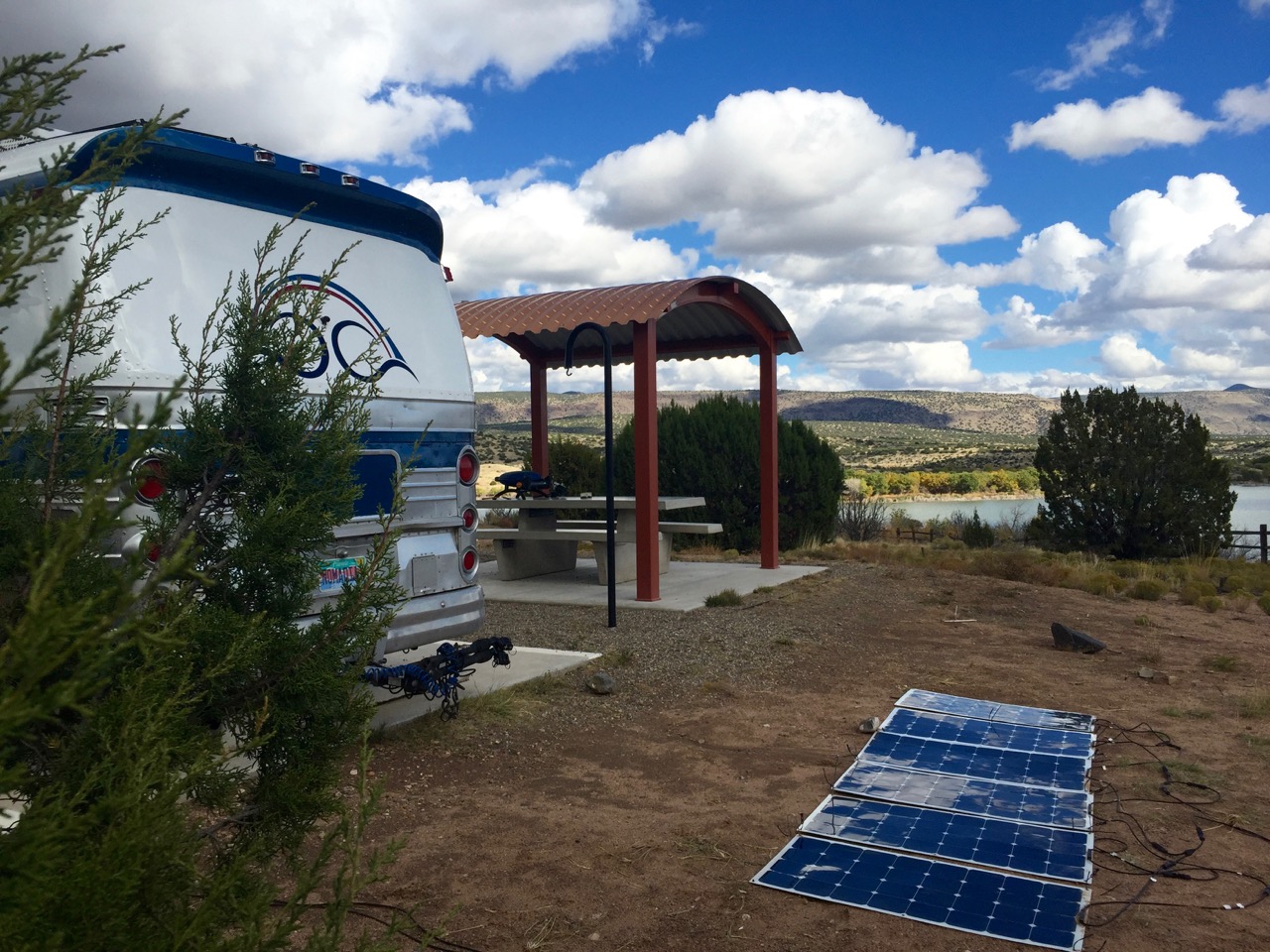
Instead of risking getting on our roof to tilt our panels, we have supplement panels we put out on the ground. Why don’t you tilt for more power? – Indeed, we could get 20% – 30% more power in the winter by tilting our panels, and when we are stopped for a long time we do have the hardware installed to do it (and have). But tilting does not make nearly as much difference in the summer (when AC is needed) when the sun isn’t at such an extreme angle.With our curved roof it is often way more trouble (and risk) than it is worth. We’d love to have some sort of magical tilting system that could be deployed from the ground (if there happens to be any enterprising engineers out there wanting to bring such a product to market – do be in touch.) So when we are stopped for a while and want extra power, we have 600w of flexible solar panels we set out on the ground.
But even with tilting and our extra panels, it would still take way more panels to go 100% solar while running an AC.
Our friends The RV Geeks just put out an awesome video & article explaining the benefits of tilting solar panels if you’d like more information.
- Do you have / need a soft start? – When our friends The Wynn’s published their video & article on running air conditioning for a bit off their solar (which they, like us, are actually running off batteries and supplementing with solar) they talked about a soft start for their AC.When an air conditioning compressor kicks on, there is a huge momentary surge current that can overload many inverters. Our Victron MultiPlus has enough momentary surge capacity that it has never had a problem with our air conditioners cycling, but at some point we may still add a soft-start kit to our roof ACs to vastly decrease the surge.
- You don’t actually need lithium batteries to do this, do you? – No, of course not. If you design a large enough lead battery system to spread the current across enough parallel batteries you can reduce the impact of pulling high-currents. But you can only do so much to get around Peukert’s Law and your lead batteries draining extra quickly when under such a heavy load.And that just means you’ll need more solar and/or generator time later to make that power loss back up.It can be done – but it has disadvantages compared to lithium.
- Seriously – running a roof AC off solar is no big deal… – Indeed, we’ve said over and over and over that it CAN be done, especially if you make doing so a primary design goal building or refurbishing a rig from scratch. That is why our featured post on the topic is The (Almost) Fantasy of Solar-Powered RV Air Conditioning.If you are willing to make the tradeoffs, go for it! We personally prefer to head for cooler temps, so we can have a better quality of life all around by keeping windows open and being comfortably outdoors exploring.
- How are your lithium batteries working out? – August will mark our five year anniversary living with our lithium batteries, and we’ve logged more time with this sort of setup than just about anyone. We’re planning to do some stress tests on our batteries once they reach five years old to see how they’ve aged, and will issue another update on our batteries and power system then.
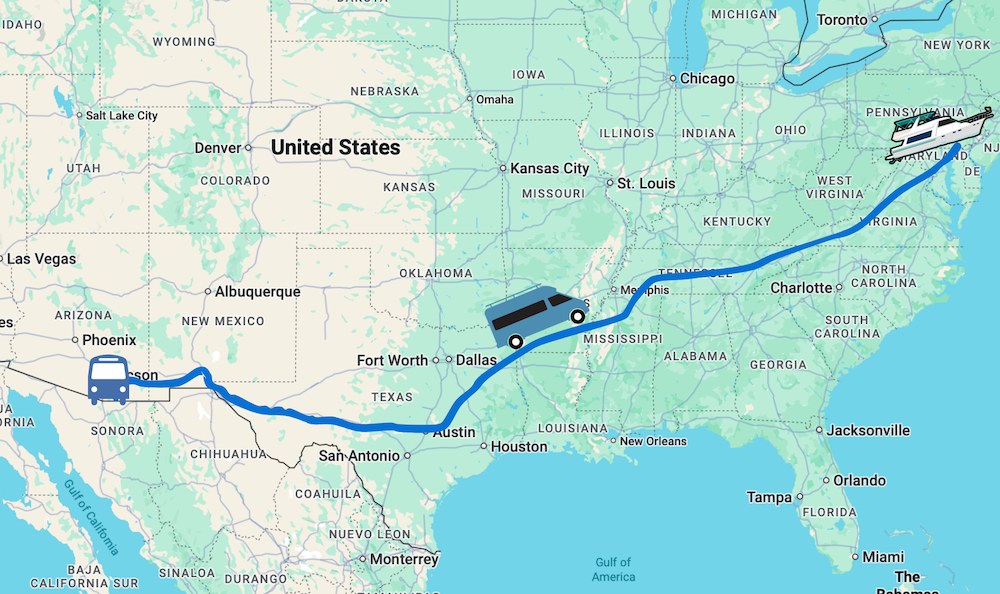
Until then… keep cool and carry on! We’re making our way north to cooler temps to escape the drone of our ACs.
You could get that AC purring along if you wired your system for 48V. I’m guessing the reason you don’t is because it’d require too much replacing of already-laid wiring? We’re looking at installing a new solar/batt bank in our coach and, unless I’m missing something, it seems like 48V is the way to go for converting to 12V to 120V. Am I missing something?
If we were re-doing things from scratch with a conversion – we’d go 24v or 48v for sure.
We actually just converted our boat from 12v to 24v (easier access to wire runs).
Thanks for all of your useful information! We are looking for an energy efficient RV and were wondering if you have recommendations on which Websites would list this type of RV (e.g. where did you list Oliver – or where would you look if you were downsizing). Thanks!
I honestly don’t know what the current sources are.. haven’t shopped for an RV in many many years.
I am so very pleased to have found you! I’m a senior who just “went for it” by ordering, sight unseen a 2018 Roadtrek with an outback package. I’ve never even been inside a Roadtrek.
Duh!!, but this is so exciting that I’ve had plenty of dream time on top of the thrill of actually using it. Hope to meet you on the road. I’m a big fan. Joan G.
Was reading some threads at Solar Panel Talk. The primary commentators there absolutely despise LFP technology and believe that LFP batteries will fail at three years. We are at 4.25 years on our 5th wheel system and have found nothing to indicate any noticeable loss in energy storage capacity. Should like to know how your battery suite is working at six years.
Reed and Elaine
Check our lithium page – https://www.technomadia.com/lithium – we did a video recap back in October.
Have posted earlier on solar/battery suite air conditioning: we
can go 4 hours in our 34′ fifth wheel and about two hours in our Roadtrek. One thing we just tried was using aluminized sun screening to decrease solar loading. We purchased a 7′ x 8′ section of something called Aluminet. This has reinforced edges and 5 eyelets per side. We kludged a fitting onto the rear of our 5th wheel (we were oriented so this faced south). It worked extremely well and did not have to use a/c for three weeks camping in Colorado. This is a very open weave netting that allows air to flow through and there is no heat buildup as might occur with an aluminized tarp. We plan to get two more sections of 8′ x 12′ for the slides (which happen to be 12′ long).
Reed and Elaine
How is the battery test going? We have had our system up and running for 5 1/2yrs now, lithium solar was a very early project for us living in Australia as the temps here are extreme inside the bus/motorhome. The early tests using lead acid showed we needed a new technology, so that was the start of researching and testing lithium batteries. Happy to say that with hundreds of system out there now that we either did or assisted in building, even via email and a private forum, we have had no failures to date and many systems are 24/7 power set ups and also over 5 yrs old.
So, please update the blog with the latest battery findings, did they improve after a solid work out and regain their lost capacity?
T1 Terry
We’ll get the blog post up soon, but we did already release the video version earlier this month. You can find it on the main Lithium page – https://www.technomadia.com/lithium
OK. It is now The day after Lanor Day 2016. In other words, I waited until the end of Aug. 2016 for your 5 year update on your electrical mods. You said you’d do the update in August, it is September.
I look forward to this forth coming comprehensive post.
Cheers and Live Long, etc.
Yup.. we’ve fallen behind. Non-work projects tend to do that. Especially ones as large as this post will be. We’ll get there. Sometime. In the meantime, we’re focusing on enjoying the places we visit 🙂
Hi guys,Been running lifepo4 for three years now with out a problem,we live in New zealand.no real need for ac over here.bought 300ah batteries with bms & ballanced locally but had to hook up myself as no one here really knows or wanted to know about using lithium.just got info of your site & any others that i could find,thanks heaps!.only have a 7 mtr bus with 390wt solar, mppt cont,alternater charge & little 2stroke gen to change on wet days when not plugged in.our main draw is the 12vt fridge, about 4.4amps,two tv’s & diesel heat for the winter.We do not live in our unit full time but try to get out once a month.
Hi Cherie,
This is in response to your comment about an “Enterprising Engineer” to bring a tilting system to market.
If you would like to send me a description of the requirements of this system and maybe some close up pics of your solar panel mounting hardware, I have several ideas to accomplish this task.
Hi Mike… our installation was done at AMSolar.com. We have the GS100 panels, and their rocking tilt kit brackets. Goal? Being able to tilt (and un-tilt) the panels without getting up on the roof.
Son finished solar/LFP setup on our recently purchased 2002 Roadtrek 190: 415 W if solar and 360 amp-hours (12 V nominal) of Manzanita Micro batteries (CALB cells). He installed a blower that will exhaust 4 volumes of air from the electronics area per minute. The batteries were trialed for an hour running the a/c, which is approximately 1 kW. We are on way to Labrador/Newfoundland.
Reed and Elaine
I think it very interesting to hear the Victron doesn’t complain about the momentary surge from the A/C. I recently installed the Magnum 3000 Hybrid running my entire 30 amp RV. It seems to run the A/C no problem even with my tiny 100 AH stock battery bank which will be upgraded next (for about 30 minutes). However it does usually log an overload condition in it’s fault history along with a momentary beep, just like it did in the Wynn’s video. It also does not like a hot handover from shore to inverter with the A/C running usually shutting down with overload for a few seconds.
When evaluating the Viltron vs Magnum, Victron published almost no information on surge capacity that I could find, while Magnum has detailed surge capacity listed in their specs. I wonder if the Victron really has more surge capability or simply doesn’t log or complain like the Magnum of those momentary surges, I was really disappointed with Victrons documentation compared to Magnum which was part of the reason I went with Magnum.
If there is enough other stuff turned on, the Victron will still log a momentary overload – but not always. It seems to handle the AC surge most of the time without even a temporary fault.
But you can disable the audible alarm, so it never has been an issue.
I do occasionally wish for a 5000W Quattro so that multiple loads engaged at once would cease to be a worry at all.
As for manuals – I read through the Magnum manuals a few years ago and found them pretty sparse, but maybe they have improved them. Victron has a lot of more detailed documentation online to be found if you dig, but it certainly can be hard to find. But I do like that they are developing a lot as open source, and you can actually go check the source code if you want to.
That sort of openness is super cool.
Cheers,
– Chris
Hi Justin the way to “fix” the overload surge is to add a Micro Air Easy Start unit. https://www.microair.net/collections/easystart-soft-starters/products/easystart-364-3-ton
Yes since posting that last year I did install a Micro-air Easy-Start and it solved the issue.
Great Post, always neat to see what you’ve got setup. Thanks
A great blog, thanks
Great info & well done, as always! I’m soaking up all I can learn about solar and battery technology. Folks who are willing to share and teach others are generous indeed. Cheers to you guys! Hey, I forgot to mention (when I was singing the praises of Pocahontas Co. WV) that, for those science geeks among us (you know who you are:), the National Radio Astronomy Observatory is here. Oh, and the forecasted low temp for tonight is 47°, tomorrow’s high will be 63°. Just sayin….
Hi Cherie & Chris !
We read your excellent blog from Europe, also preparing for some technomadism on our side.
One day, you’ll probably need to get new LFPs, yours 100Ah GBS are excellent, but you should rather use long shaped, horizontal LFMP-200Ah, the third generation from GBS.
Connectors are on both sides, with a better electrical flux inside, for a better efficiency, avoiding inside flux crowning.
I read your article about your LFP usage mentioning a loss of capacity, probably caused by LFP temp, left unmanaged.
On our side, we plan to regulate the LFP pack temp, by heating/cooling it, to get the optimal temp.
The other enhancement as far as the BMS is concerned, is active cell balancing.
This feature allows to move energy from the pack to the weakest cell, without interrupting the LFP pack current flow, of course. But it requires some specialty electronics.
This is a huge enhancement, comparing to the nowadays situation where the LFP stack is cutoff when the weakest cell reaches the lowest affordable voltage.
Sort of squeezing a lemon, with all cells reaching the secure lowest, following the max DoD and extending the lifetime.
Indeed – there has been a lot of improvements in what is possible with LFP using today’s technology. When we get around to upgrading, we’ll build an even better battery bank. But for now, we remain thrilled with the five year’s use we’ve gotten.
– Chris
I also use LFP cells from many years, but smart electronics are required to worth the long-term investment.
Runtime specs of these big cells are complex to comply with, without electronics, to get the 5000 cycles @ 80%DoD
Also, dual cell array with FET adds redundancy and 24v/48v system enhances overall efficiency.
Closer to the full electric RV concept, perhaps.
BTW, why are you not using a wind turbine, as a supplemental source?
Wind turbines don’t make sense for our mobile RVing lifestyle. They’re loud, require setup / take down at each stop and not all places US RVers go have the right wind conditions to make them worth the effort.
It could totally make sense for others with different goals. But not ours.
For around the clock battery loading and silent energy source, would you consider using methanol-based fuel cell, like the EFOY, popular among RVers ?
I mean for boondocking mainly, to avoid using a gen.
So even if I was very very rich and bought a 2 million dollar coach ( lol that’s not happening ) I still would be limited running an air conditioner?
With enough money and/or design effort – lots of things are possible. Everything is about trade-offs.
Thank you again for your information. My husband and I love learning from you.
Could you tell me the reason for your induction stove top? I thought gas would be better while boondocking?
When we first bought our bus, the propane systems were very unsafe – so we initially went all electric. Here’s more on the decision, and why we selected the induction: https://www.technomadia.com/2012/02/our-propane-free-goal/
With our electrical setup, induction cooking is fantastic for boondocking. Propane cook-tops dissipate a lot of extra heat into the living space, which on a hot day, isn’t fun.
Definitely time to increase elevation. But at least you have an alternative for a case like this, when the social calendar conflicts with Mother Nature’s.
Increase elevation, or increase latitude 🙂
Oh man, I LOVE this stuff. I’ll geek just for the sake of being a geek. 😉
20160606
Hi all,
I’m often in situations where I have only 15 amps to play with.
I am adverse to running the roof air when voltage drops below 108.
I do not yet own an autoformer.
The Magnum inverter charger offers load support, but not voltage support.
The test:
to run roof air on 1/2 of a 50 amp outlet with 70 feet of #10 extension cord (one plug at 30 feet, and one at the RV). Load support enabled. Input current limited to 30 amps.
The results with voltage measurement inside RV.
Line voltage only the fridge as a load 109. watts 335 0 load support amps
Line voltage with air conditioner and fridge on 105.3 watts 1695; 17 load support amps.
Line voltage with only air conditioner 107.3 watts 1437.
———————————————————————
running on inverter only–no shore power
voltage only the fridge as a load 117.7 320 watts
voltage with air conditioner and fridge 118.7 1673 watts
voltage with air only 118.7 watts 1385 amps 137
———————————————————————
I then deliberately “dialed down” current input to 5 amps.
line voltage running fridge only 111 volts 320 watts
line voltage running air and fridge 109 1685 watts
line voltage running air only 110.8 1387 watts load support amps 54
———————————————————————
Conclusion, it is possible to force the Magnum to do voltage support by “dialing down” the input current limit.
This is EXACTLY why we recommend you two as a wealth of knowledge and experience. Well done! And thanks for the link love, too. Hope you’re having a nice trip north and headed for cooler weather soon. If it makes you feel any better, it was 93 here yesterday… in BC! =:-O
93 in BC?!?! Gads! Is there nowhere safe to escape in the summer? 😉
Sounds like you guys should meet us in Nova Scotia instead 😉
We LOVE NS!! It is our second great Canadian love. Wish we could join you there, but family visiting us this year would be lost in Vancouver without us. lol Have a blast and we’ll be enjoying vicariously.
You are true pioneers. Thank you for sharing your innovative ideas.
Thanks for showing and explaining – excellent demonstration of how RV solar works! Love the colour monitor too!
Hi, Thanks for the lovely spontaneous video. I was wondering what the voltage drop was when using the Victron with 15 amp shore power to support running the roof air conditioner.
I often do this with my Magnum. However, I have noted lower voltage in what Magnum calls “load support mode” vs running 100% from the inverter with no shore power in the mix.
I hope to “fix” this voltage drop during load support by adding a Mexican Autoformer.
The hybrid inverter is the 2nd best modification I’ve made–the best being a modest 256 watt solar system.
Regards (and thanks)
Don Rose (aka Pianotuna)
Hi Don –
The voltage drop from the shore depends entirely on the quality of the shore power, and perhaps on the length and quality of your extension cord. We have a 50′ 10-gauge extension cord that doesn’t drop the voltage too much, but if we have to use a longer and thinner cord the voltage can get a bit low when under max shore-power load.
I usually just dial the shore power limit down even further and put more load on the batteries, but an Autoformer to boost the shore current can work too.
Cheers,
– Chris
Hi Chris, I’ll try a little experiment tomorrow during the heat of the day. I’ll “dial down” to just 5 amps of shore power, and check the voltage in the RV. Then, I’ll “dial up” to 30 amps (the RV is 30 amp). Finally I’ll disconnect and run 100% from the inverter.