
Oct 31, 2016 Update: Telsa just recently announced the Powerwall 2, and we’ve started getting questions on it too. Here’s our take on it:
From an RVers perspective, I don’t see any practical difference between the PowerWall 1 and PowerWall 2.The big change with the PowerWall 2 is that the inverter is integrated and not a separate box anymore. This integration might actually make it harder to merge into an RVs systems – but no detailed technical information has been made available at all.The cost per KWh is great, so I imagine some enterprising hardware hacker might find a way to integrate this into an RVs system at some point down the road once they ship next year. But for now, it really isn’t very interesting for most of us mobile folks.
Ever since the rumors hit last month about Tesla releasing a residential battery, we’ve been getting questions about it…
Might this at last be the RV battery revolution we have been waiting for?
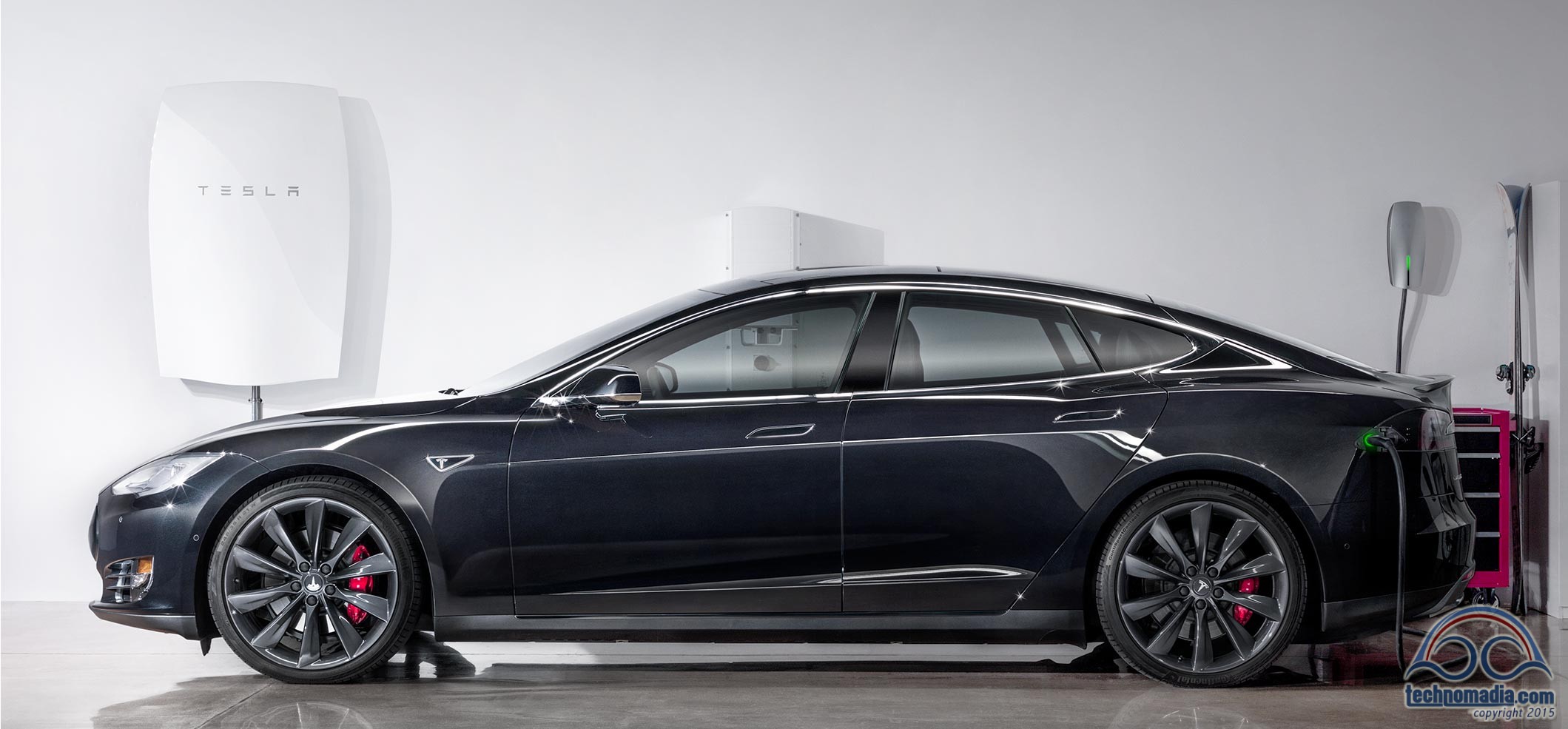
Tesla Motors last night at last revealed some details – announcing their first product that is not an electric car: the Powerwall Tesla Home Battery.
As Tesla describes it:
Powerwall is a home battery that charges using electricity generated from solar panels, or when utility rates are low, and powers your home in the evening. It also fortifies your home against power outages by providing a backup electricity supply. Automated, compact and simple to install, Powerwall offers independence from the utility grid and the security of an emergency backup.
The $3,000 7kWh Powerwall model intended for “daily cycle applications” weighs just 220lbs, but offers the equivalent usable energy storage capacity of a massive bank of 1,000Ah of lead acid batteries – roughly four huge 8D’s. And for even more capacity, multiple Powerwall units can be chained together.
And thanks to Tesla’s liquid thermal control system – the Powerwall batteries are fully functional from -4°F to 110°F too.
All backed by a ten year warranty, with shipments beginning later this summer.
Wow – sounds perfect for an RV, right?
Not so fast…
Powerwall = Too Tall
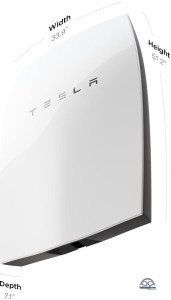
The first problem to consider is the size.
True to its name – the Powerwall is designed to mount… on a wall.
Ideally in a garage, or on the side of a house.
Though it is only 7.1″ deep, the Powerwall is well over 4′ high, and nearly 3′ wide. Not even the largest bus conversions have the bay height to mount a Powerwall down below. Unless you get crazy and mount it on a living-area wall, or the rear cap of your RV, a Powerwall just isn’t going to fit.
And though it is not confirmed – presumably due to the liquid thermal management system, the Powerwall “must be wall mounted” and not installed flat.
The other catch is that the Powerwall battery operates internally between 350V – 450V, though it presumably can down-convert and output 48V to interface with a residential solar inverter.
But 12V or 24V output is extremely unlikely – making the Powerwall nearly impossible to interface with typical RV power systems.
And the final catch for using a Powerwall to power an RV…
Tesla will only be allowing installation by licensed and certified installers. It may be a while before hackers and hobbyists can even begin to start getting creative shoehorning the components into an RV friendly installation.
But still… This is exciting technology.
And I’ve already tweeted at Elon Musk asking him to consider releasing an RV-friendly version. Hopefully he is listening.
*grin*
Posts in this Series:
The Entire Lithium Battery Series
Promise of Lithium #1: Lead Acid Battery Downsides
Promise of Lithium #2: Lithium Ion Battery Advantages
Promise of Lithium #3: Cost Analysis (including our part list)
Boosted Electrons = Better Views (why a boosting inverter rocks!)
Project Notes:
2/2015 – Living the Lithium Lifestyle — 3.5 Year Lithium RV Battery Update
7/2013 — Living in a Parking Lot — Practical use example of our LFP & Boosting Inverter
2/2013 — Lithium Dreams, Lined With Worry? (Response to Boeing Dreamliner Battery Fire)
8/2012 — Our 1 Year Update on our Lithium System
8/2011 — Build Notes: Lithium Ion Battery Success!!
8/2011 — Build Notes: We Built a Lithium Ion Battery Bank
8/2011 — The idea is born: Inverted Intentions (August 2011)

Doing the leg work now for RV installation of the Powerwall in an RV, an Allegro 36LA, high on the rear cap, (safety first).The main point of mounting a powerwall on an RV is to go FULL TIME 120 volt so everything works,,all the time. All the 12 volt components can back feed from the stock 110 to 12 rig converter. Sure there is going to be some lose, but having 110 all day long every day outweighs grampa’s 12 system.Back stopping the system with 2- Honda 3000si generators tied together for short fast low DB charge rates.
The downside so far is the powerwall has to be installed on the house, which will last about as long as it takes them to disappear from view pulling out of the driveway. Then it goes right on the rig, Full time rig, towing E450 work van, with SMI brakes. Nothing like a 22.5 inch tire and beefed up springs from ATS springs in Souderton PA, from 24 k, to 32 k.
All the best.
I’ve seen some people use junked Telsa car batteries in some awesome RV installations, but you are the first I’ve heard who will actually use a residential Powerwall.
Why not go with a more RV-appropriate system and form factor?
I’m eager to hear how well it works out for you. Good luck!
I don’t agree with the point of compatibility. Surly, it doesn’t work with the 12V system. But what if the RV totally use 110V AC power instead of 12VDC. With 110V AC who will need DC? the DC battery solution is a solution limited by the old technology. But now, why not just start change everything?
Also the fridge, with the big capacity of power wall and the solar panel installed on RV I will assume we can use the domistic fridge, and domistic Airconditioner from power wall. That will be awesome.
Also it will be much easier to maintain since we dont have 12V and 110V duel system.
for electricity, by consuming the same amount of power, the lower the voltage, the higher the amp. That means the amp of 110v Ac system will be much lower than 12VDC. the Cable can be smaller, and the system can be even more easier to hook up on camp site.
I believe it will make electricity system of RV much chaper.
All electrical systems waste power converting from DC (batteries) to AC, and a lot of AC appliances actually use DC internally and waste power again converting back. For low-current devices, it is a lot more efficient to stay DC across the board. AC only makes sense for the high power loads.
In other words – an RV that ditches DC systems entirely really doesn’t make too much sense. But if anyone experiments doing so, I’d love to hear about it.
Cheers,
– Chris
It seems the PowerWall 2 offers some important differences. It is a bit smaller now. It can be mounted flat (aka the roof of a basement bay could be ideal). Also, it seems the installation doesn’t have to be all so integrated and complex. If the powerwall is essentially wired between the shore power and the coach, it would do almost everything you want. The cheap power is the equivalent of paying for an overnight site and charging while on shore power. No further integration with the 12 volt system or the coach inverter is really required. It would supply 110, 30 Amp until it couldn’t and then everything else would work as it does today when not on shore power. Or you may be able to wire it for 220V 50AMP with the new 7500 watt inverter built into the powerwall2 but I wouldn’t think you would want to consume it that quickly so I’d keep it at 110/30A max. I think it would run for 4 hours at that max 110V output = 1 roof air. Or much, much longer with more reasonable loads (like a residential fridge) The existing coach inverter would sit idle knowing that 110 was being supplied from shore (aka powerwall). You may want the option that when the generator was running, the powerwall would recharge from the generator – or not, with an on/off switch for that. So leave the existing batteries in place with existing solar/inverter etc. and pretty much stick this on the shore line. I don’t think it has to be overly complicated but maybe I’m missing something.
It seems like it would be even simpler just to integrate LFP batteries into the existing RV inverter/charging system rather than shoehorn a PowerWall into the mix – but I am pleased that the PowerWall 2 makes integration a bit easier.
I am eager to hear of the first person who actually attempts this.
Cheers,
– Chris
Chris, I just read that the Powerwall 2 is designed to mount horizontally as well as vertically. How does this change your view for RVs?
Where did you run across that it can work horizontally – I have not seen that.
But regardless, all the other downsides I mentioned remain – especially the mis-matched typical voltages.
Cheers,
– Chris
You should check out the upcoming Orison battery. It too may not apply to RV’s but it is another home battery.
There seems to be a huge number of these sorts of home batteries coming to market, especially in Europe because the power companies usually do not buy back excess power so it is critical to store it.
The designs needs of home batteries and RV house batteries are often hugely different though, but more overall development and expertise in this area is good for everyone.
– Chris
Will be rv-ing full time soon
Want the best solar system for it. Want Tesla products. What’s out there for Pacific Northwest.
Check out AMSolar.com – they’re in Springfield, OR. Highly regarded for solar for RVs.
Elon Musk said a lot last week. Apparently the cost of a kWh of cells, the new larger cells from the Gigafactory, is around $100. Eventually this has to work its way through the marketplace. I watched your stream on lithium last night. I was Googling some of the suppliers, and even the RV specialty stuff, right now, is not too bad. But the car companies and LG Chem are really driving the costs down and it feels like we are waiting around to see when their costs transfer over to RV systems and Ebike batteries.
The big jump is feeding an air conditioner. If you look at the costs both GM/LG and Tesla/Giga are putting out, the raw cell cost for a 20 kWH bank would be $3,000, Double or triple that for charger, controls, and inverters and it’s still reasonable. And it’s still maybe 20 hours of air conditioning, with no obvious way to restore the energy in the battery bank. The standard now for cars is 60 kWh so 20 kWh is not that big a deal.
It will all break wide open in the next couple of years, as the electric cars move along. The costs they are throwing out are today’s costs. The Bolt has a cost profile, right now, since it is in production. GM says $145 a kWh.
I’m not going to wrap my RV around an air conditioning unit. I still like the minimalism of a basic RV. But clearly the technology pushes things along to make things like AC much more practical. If that’s what you want, you’ll probably get it soon enough.
I think an electric RV is interesting. I’m not sure how efficient they could make it. Perhaps something like the Ultravan. But if you covered the roof with solar and had a slippery design, who knows.
I hope Musk responds to your Tweet. I really hope the Gigafactory tech is going to be available to the RV and Ebike communities, that sort of thing.
Thanks for the stream last night.
Tesla Motors is planning to build their battery packs at the Gigafactory, but Panasonic will be manufacturing the cells under the same roof with a leased portion of the building. Most auto manufacturers are sourcing their cells from an established manufacturer and assembling them into packs. I think that BYD is the only company doing both.
I don’t know where they are coming from, but there are usually Tesla Motors Model S battery packs (or portions) available on eBay if you want to DIY. Prius battery packs are hard to find since they are NiMH and somewhat more forgiving and better able to handle temperature extremes. The main battery from an early Nissan Leaf could be configured into a good RV battery. The Powerwall isn’t likely going to be a good drop in for an RV. The first ones limited the output to 1kW, not even enough to run a microwave. Tesla Motors doesn’t publish much in the way of specs for the current models.
If the PowerWall does indeed output 48vdc, this is not a problem for a new RV build. There are 48vdc 110/220 inverters. You can also install a DC-DC 48-12 buck converter for your dedicated 12v lighting and appliances (although I have seen 48v compressors that could replace the 12v compressor in a fridge. Plus, there are 48vdc mini-split and self-contained heat-pumps/AC coming onto the market. Basically, replace your inverter plus add a converter and you should be good for even an existing RV solar installation using a 48 vdc output MPPT controller (unless the PowerWall already has a controller). Or, is the approx. 400v internal voltage indicative of wiring the solar panels in series at high-voltage (and is it a requirement)?
If you are designing an RV from scratch, going with 48V makes a ton of sense. But if you are designing from scratch, you should be able to build up your own battery system to fit your exact needs without trying to shoehorn a system very much optimized for residential usage into the design.
If you can find a spare PowerWall cheap though and you are the hacker-sort building a complete RV conversion from scratch, sure, go for it.
Cheers,
– Chris
My partner has been researching this and emailed the folks over at Tesla – maybe one day we RVers can utilize this technology! Came across your post here while reading all about your solar…might be emailing you guys soon, we want to be all electric too…
Although I see now to NOT email you guys, so I’ll just ask questions in the comments when/if we have them. I get it, we get lots of emails too…it’s hard to respond to all of them. Anyway, thanks for all you do here, everything I’m reading is so helpful!
Thank you for understanding.
Hello, I want to get a RV within the next 6 months and travel around Australia with a large hairy dog. This will only be possible if I can get some air conditioning for the vehicle whilst stationary, it is far too hot to leave a dog in a car , without an air conditioning unit of some kind I would not be able to even go to a supermarket leaving my dog in the vehicle. I’d also like to do a bit of sight seeing and it is not always possible to take the dog with you. Do you have any options for me please, if I can’t get a Tesla or similar I just wont be able to go. I am OK with mounting the unit inside the vehicle upright somewhere, I’ll do without a closet if need be, I am not into home beautiful, thanks, I hope someone reads this,
cheers gail findlay
gfindlay1@bigpond.com
The easiest solution is just to pick campgrounds with electric hook-ups to leave your RV at while you’re off exploring.
Otherwise, designing off grid air conditioning is a very difficult challenge. Check our https://www.technomadia.com/lithium and https://www.technomadia.com/solar posts for more information on these topics.
I could easily mount 4 of these units under my travel trailer
That would be quiet a trick, since they are designed to be mounted vertically. 😉
– Chris
Having a battery like Tesla’s in an RV application should actually be easier than you’d think since most people don’t use nearly as much power in their RV as even a small home or apartment. A battery would power the RV without the need for a gas or diesel generator would be an instant hit and something that would probably outsell a home application at least initially.
It has been possible for years to build your own equivalent high-powered RV battery system – and more and more RVers are doing so. Our 500Ah lithium system and 3000W inverter powers all of our energy needs.
But the design requirements are a bit different than what Tesla has built.
It is certainly an opportunity for other companies to tackle though – Volta Power Systems seems keen on building theses sorts of systems for the RV market, and I’m curious to see their first products out on the road.
– Chris
Tesla is late to the market (not even there yet) with their Powerwall line of home batteries. Companies like Bosch are already shipping a wide range of products with worldwide sales and support. The rumored price of the Powerwall is also more than comparable Bosch system when you consider that extra bits are needed with the Tesla product to make it a complete system. An article I was reading also mentioned 3 or 4 more companies with similar products, but none of them come to mind at the moment.
The specs on the smallest Powerwall product shows it only capable of delivering 1kW, less than the consumption of a common microwave oven. The full specifications have somehow gone missing from the website. They may be cached somewhere, but I didn’t grab an image of the page (darnit).
With the increasing popularity of electric vehicles, it won’t be long before used batteries are easy to find. I know an artist that is building a wild electric trike around a used Prius battery pack (NiMh) he was given. The battery from a Nissan Leaf won’t have a white shiny exterior, but will likely have around 18kWh of capacity left to use when it’s time to upgrade the car to a new pack. A new battery is 24kWh and is around $7k.
Chris’s power system seems to tick nearly all of the boxes for a very good off-grid/on-grid power system. It’s also easy to expand with more batteries in bit sized chunks.
The Tesla Powerwall is a great start on better battery technology. But the real revolutionary technology is Graphine with over 100x the efficiency of conventional technology. GRAPHINE BASED: Batteries, Super Capacitors, Solar Panels & Electric Wheel Motors that can be retrofitted on your existing RV Car or Truck. Call your Congressman and demand more research and grant money to bring Graphine products to market now!!! Then we can all drive fuel free forever!
Graphine is interesting theoretically – but it seems to be a long way away from being practical. If any company figures out a viable way to bring such vastly more advanced batteries to market, they will make a fortune. That is a pretty strong incentive.
I think you’ll have more luck lobbying Tesla than Congress – Tesla would have something to gain if they figured it out.
Cheers,
– Chris
What is even more exciting is the advent of a new form of MXene clay that may well effect radical change on electric power and batteries. Even now, “the state of the art” is Lithium Ion batteries, highly effective (and expensive). With this MXene clay a much more cost effective way to create what are the very expensive electrodes used in these highly sophisticated batteries. This will (if all reports are true) reduce the cost of Lithium Ion batteries significantly and, it will make them even more efficient. The possibilities are endless!! A sight more effective I believe than nano carbon air electrodes…..
There are indeed a lot of exciting developments – but it takes a long time and a lot of effort to transition from the lab to the mass market. What is exciting about Tesla is that they are actually shipping products, not just talking about future potential.
But – yep – things will keep getting better, for sure.
Cheers,
– Chris
I agree however Tesla will probably be the biggest beneficiary of this emerging technology. Remember, the breakthrough in the emergence of his Tesla car was the technology that he licensed from NASA whereas heat from electric motors (loss of power and efficiency) was overcome by patented technology that NASA developed. This NASA breakthrough significantly reduced the loss of power through heat dissipation hence providing greater efficiencies with the Tesla motor. That being said, the Achilles heal is still the massive inefficiency of the the batteries that all electric cars (including Tesla for the most part) are forced to use. These batteries are still too expensive and too inefficient (and dangerous at times).
BTW, this technology I think will also significantly impact Tesla’s Home Power Wall that it is getting ready to sell. I hope that his engineers are looking at this closely.
Creating new capacitors and electrodes out of Mxene material in my opinion, be a game-changer that will finally make electric power much more efficient, flexible and hopefully cost effective. It turns out that the license has been acquired by a major defense contractor and it is my guess that the time to market will not be as long as one might expect. It is going to be an interesting ride of which we all will benefit.
Hello…i have a 1946 Spartan Manor…and still with all of these great points fully intend on installing one of these bad boys in the living room area of my vintage lady. Will keep you updated in the future if your interested. https://photos.google.com/u/1/search/spartan/photo/AF1QipOamrCegg4LCHEcOrvzgPWksV_cEM1zrXqVp9rn
Fantastic blog, happy travels. Thanks for sharing. We’re currently traveling globally as a family and we’re thinking of take a “break” by RVing around America. Thanks for all the great info.
Heck! Why not go all the way with electric. This would take RVing to the next level …
http://www.slate.com/articles/technology/the_juice/2014/09/electric_buses_proterra_wants_to_rid_america_of_emission_spewing_buses.html
I fantasize about having an electric bus – but an $800,000 chassis that gets just 30 miles to a charge isn’t going to make an interesting RV conversion anytime soon.
But someday the technology might get there – it is exciting to see some progress being made!
Yeah, we’re eyeballing it for the boat as well. We probably have more options for mounting than you do in an RV but still…that’s a monster to cram into small spaces. Hopefully more options will follow. One thing I’m excited about it perhaps the ripple effect across our industries to perhaps drop prices of the solutions (current & road-mapped).
PS-It was great to meet you two at Drew’s screening in Austin!
M&M
Too bad it doesn’t seem to actually charge via solar yet…
http://www.bloomberg.com/news/articles/2015-05-06/tesla-s-new-battery-doesn-t-work-that-well-with-solar
Oh well, something to look forward to, eh?
…what about trailers? like an Airstream? (presuming that, yes you have a place to hang the battery) …or an Earthship House? I’m trying to get an idea of how much better a Tesla Battery is compared to the battery solutions people are using already.
As Chris wrote.. the Powerwall is ideal for stationary home use, not RV use (trailers are RVs). Lithium in general however has been used in a few RV applications in the past few years.. browse the links at the end of the article to go over all of our articles on them. We’ve been running LFP for nearly 4 years now.
My Airstream would be stationary, as in a live in “tiny house” application. Specifically used as a temporary house until I could compete construction on an Earthship. – I’ll check out the articles for sure.
Am I the only one missing something here? Everyone seems to be focusing on the aspect of stepping down power to meet 12/24 volt needs. Why? Tesla’ s new battery is designed to be a whole house ac/110 system ,right? How is this any different than shore power? With a permanent full time 110 ac power source in our RVs ,who needs 12/24 volt anymore? The vehicle starting / electrical system can remain separate without issue can’t it?
Hi Zach —
Residential power is indeed 110V AC, but batteries can only store DC power. In the case of the Powerwall, it is 400V DC internally, and it has a DC-to-DC converter built in that gives it a (presumably) 48V DC output.
The Tesla Powerwall needs a separate residential solar inverter (presumably already installed in the homes most likely to buy a Powerwall) to convert 48V DC from the Powerwall into 110V AC for use in the home.
In other words – it is very much not designed with the needs of RVers in mind.
– Chris
I’m sure Tesla operates on a far bigger scale than the RVers who’d want high end batteries for RV solar, but it sure would be nice. I hope some company that does operate in this market can adapt the technology to fit the RV needs, I think this is quite amazing and I hope it all proves to be as advertised.
Hopes for the future…. 🙂
One other thing not mentioned in Tesla’s PowerWall product page is the exact materials they are using; it could be LiFePO4 like Technomadia’s (and then it would be very safe re: fires) or it could be Lithium-CobaltOxide which has shown less than stellar results (see the Boing 787 fiasco, for one glaring example). Of course LiFePO4 costs more for the same capacity…
Until I know that for sure, I would not put any money on Tesla’s product, even for a house.
It’s probably a safe assumption that with a company like Tesla, who excels at being more then cutting edge and launches space ships – they are using the best chemical composition possible.
Cool. 🙂
I am excited to see significant steps like the Tesla Powerwall. This can only increase the general public’s awareness and understanding of battery technology leading to an increased demand. With Tesla’s Giga Factory in Nevada coming on line in 2017 I hope it also pushes down the cost of entry for lithium ion across the board.
No matter if the Powerwall isn’t for the RV community, I think it will still have a huge influence in the sector as a whole.
I created my own powerwall about a year ago, although I don’t have a fancy name for it. It consists of the 110v version of this and a remote monitor unit: ($620 including shipping)
http://www.mppsolar.com/v3/pip-ms-series/
And my own 24v battery bank. Currently it is 6 12V 120Ah marine batteries from Wal-Mart for $86 a piece.
Also there are 6 230 watt solar panels mounted flat on the roof.
I added a minisplit AC system, and 2 ceiling fans with 110v lighting. The system runs AC all day, microwave as needed and even my wife’s hair dryer. It was very simple to mount in one of the lower bays. And connecting the the shore power was a breeze.
I love the off grid freedom and ease of use.
RVs have a different set of requirements than a car. Lightweight and small size are not major concerns for RVs. RVs need large aH, high cycle count, and lower cost. I believe lithium based batteries are not the best solution for RVs. NiFe or rechargeable metal-air batteries like Al-air batteries are a better fit. The raw materials for these batteries are plentiful and reasonably cheap. Lithium, not so much.
When my lead batteries die in 5-10 years, I hope there will be more options out there. Options are good.
In the meantime I will continue work on my own custom battery bank using raw materials I can readily find.
Hey John. I am just getting started. I have 1920 watts on the roof and plan to go LiFePO4 for the density and maintenance. Can you give me more info running your A/C and other heavy loads with solar.
Chris actually wrote a post about running A/C off solar.. in case you missed it: https://www.technomadia.com/2015/02/the-almost-fantasy-of-solar-powered-rv-air-conditioning/
Thank you for coming out with this today. First thing I thought of was “I’ll let Technomadia sort it out and tell me” LOL Well, to hit on the size of it. IMO many RVs decor could benefit from this thing on a wall somewhere! I’d be very fine with a glossy white slab!
From the web site it looks like all you get is batteries, BMS (hopefully), and some packaging. The 10K unit (presumably wholesale price) will run $.35/watt hour. Installed it is going to be considerably more I would guess, $.50/watt hour. Tesla is offering a 10 year, almost certainly, prorated warranty.
AMSolar sells a 400AH bank for about $.644/watt hour. AMSolar is offering a 3 year full replacement warranty with years 3 and 4 prorated. AMSolars offering appears competitive even if this thing could be mounted. Assuming you could mount this thing somewhere (unlikely and expensive) getting power into and out of it is going to be expensive and require all new components, and certainly getting 12V out will be inefficient compared to 12v batteries.
My big takeaway is that Tesla is sourcing batteries cheaper than AMSolar and is willing to warranty them.
We should see LiFePO4 prices continue to drop in price. We might even see the cost of watt hours halved in the next 24 months.
In the long term it makes you wonder if having 12v systems will make much sense soon. Will coaches be all 110 soon?
I could totally see coaches in the future going to 48V DC for the large DC loads – solar charging is better at 48V, inverters are better at 48V, and you can even get 48V DC air conditioning units. For heavy loads, 12V just doesn’t make much sense.
I am pretty sure that the Powerwall uses 48B DC for input and output, but I would love to see more technical specifications and an install manual to know for sure.
– Chris
Since its indoor/outdoor (designed to wall mount on the interior or exterior) what about side of the RV?
Sure.. that’s possible.. but still doesn’t solve the voltage issue. 🙂
Thanks for the quick analysis Chris. Very exciting news nonetheless too bad it’s not RV capable, yet.