
After a major surgery a few years ago, my doctor read me my post-op instructions. The pain medicine I was on probably didn’t have me thinking the clearest, so I was confused as to why he was saying it was ok for me lift pails of oil up many dozens of steps so soon after surgery.
Oh wait, he meant I could do ‘light house work,’ not ‘lighthouse work’. There’s a difference.
And that, combined with my mother’s lighthouse obsession, planted the seed of a fantasy of working at a lighthouse.
When Nina and Paul posted about their experience volunteering last summer in Oregon hosting lighthouses, Chris knew he had no choice in this – we were having this adventure.
We’ve had a lot of questions about what the gig entails and how to go about getting it. So in this post, I’ll go over all of that.
A Bit about Cape Blanco Lighthouse
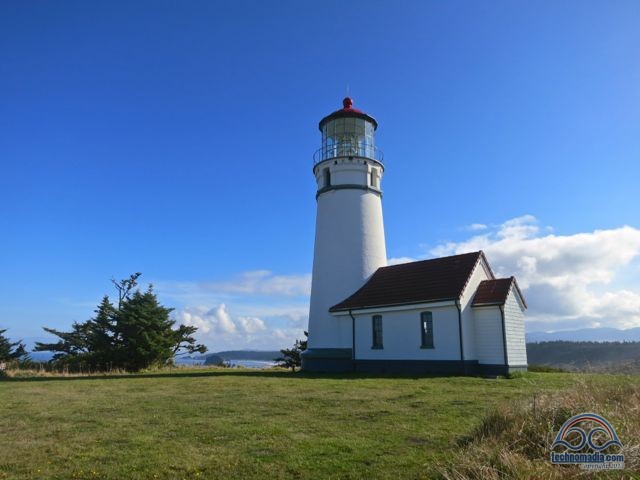
Cape Blanco is the oldest operating lighthouse in Oregon, and also the western most point in the state. It was first lit on December 20, 1870, and is still an active Aid to Navigation managed the US Coast Guard. It’s fully automated now and no one has lived onsite since the 1980s.
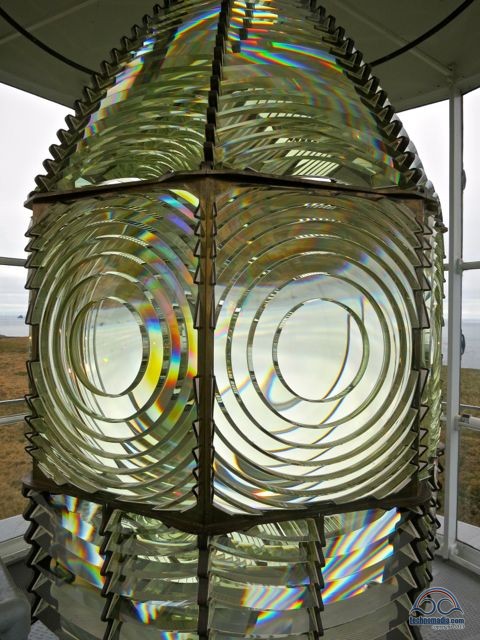
It houses a 1.5 order Fresnel Lens that was installed in 1936, with a 1000w halogen lightbulb that can be seen up to 26 miles out to sea on a clear night. It’s signature is 18.2 seconds of darkness and 1.8 seconds of light. It serves as a warning beacon to ships to stay away from the dangerous shallow reefs and rocks surrounding the cape.
Cape Blanco is one of the few lighthouses in which visitors can go right up to a fully operating lens.
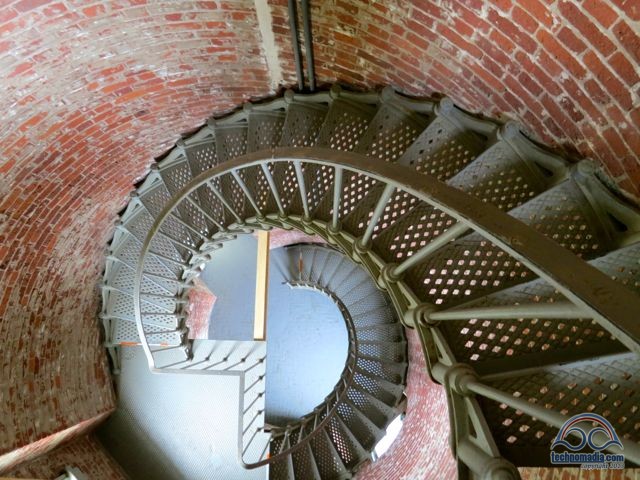
The lighthouse is perched on a 195 foot tall cliff, which means the tower itself only needs to be 59 feet tall to be effective. There are 64 steps from the floor to the lantern room.
It’s pretty remote – about 6 miles off of US 101 and about 30 miles south of Bandon. The nearest town of any size is Port Orford, about a 20 minute drive away where we have access to a small grocery store, 2 gas stations, a laundromat, post office, a library with great WiFi and a few restaurants.
Because of the remoteness, there are other no visible manmade structures other than the lighthouse out here – which makes for some awesome unobstructed coastal views and photographs.
There is a stellar 58-site campground about a mile from the lighthouse, that is completely protected by a forest.
So what I’m trying to preface, is that the location and history here is nothing short of magical.
The Gig
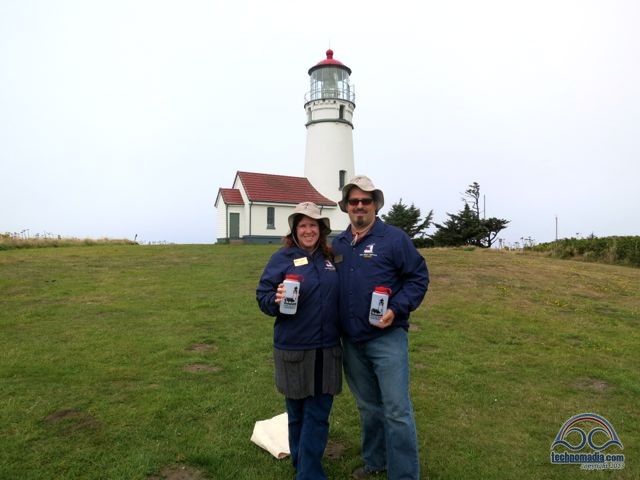
There are several lighthouses in Oregon that have volunteer hosting positions from spring to fall, and each is run slightly different depending on the needs. I’ll concentrate on Cape Blanco, as that’s the only one we have experience with. (You can also check out Nina’s post about their duties at Coquille River Lighthouse last year.)
At this location, they try to staff 4 volunteer couples to give interpretive tours of the lighthouse, Wednesday – Sunday, from 10a – 3:15p. The shifts are broken up into just less than 3.5 hours each, and are handled on a rotating basis.
We each work 4 shifts in a row (one afternoon, one full day of both a morning & afternoon shift, then a morning shift) and then a day off. Everyone has Monday & Tuesday off.
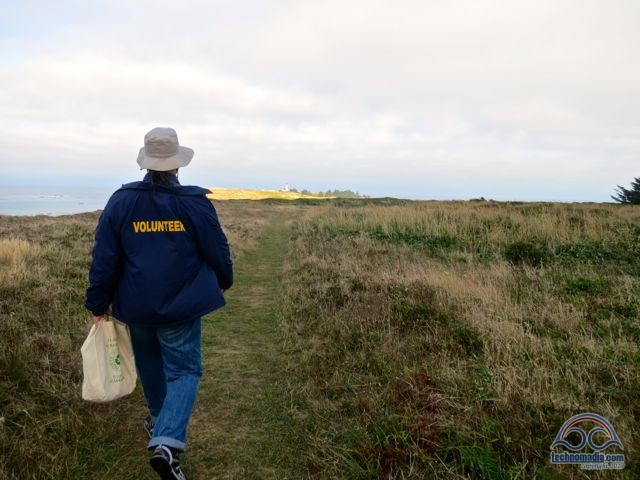
This ends up working out really well, as no one ends up getting the ‘good schedule’ every week (whatever that might be – weekends off, morning shifts, etc.).
Sometimes we might end up having 3 days off in a row, and sometimes we might serve all 4 shifts with no days off in between. It all works out nice and fair, aside from that whole two early mornings in a row thing (ok ok, some of you probably don’t consider 10a to be an early morning.. but we do!)
All and all, we volunteer about 17 hours each a week and get a minimum of 3 days completely off.
During the month of September, we seem to be getting about 100-125 tours going through the lighthouse in a day – keeping a nice steady, but not overwhelming, pace.
The Work
There are 4 positions during the tour at two different locations – the Greeting Center and the Lighthouse. Each couple serves together at the same building and the pair decides how they want to share the responsibilities. If there are not 4 couples, or perhaps some solo folks in the mix, the ranger seems to be quite flexible about things and adjusts as needed.
With each shift you rotate back and forth between the two locations. It goes like this:
- 1st Shift (afternoon): Lighthouse
- 2nd & 3rd Shift (full day): morning: Lighthouse / afternoon: Greeting Center
- 4th Shift (morning): Greeting Center
This helps keep it from getting too monotonous – 3 hrs flies by quickly, and just about when you’re tired of telling the same story over and over again, the shift is done.
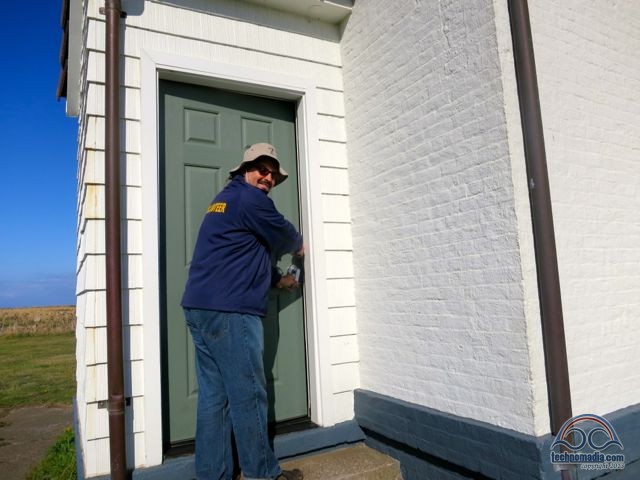
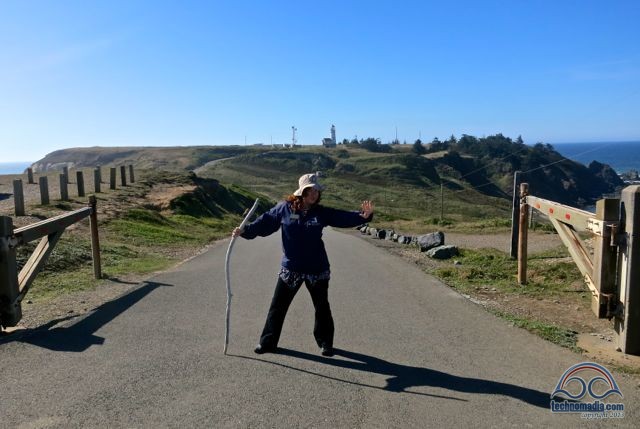
There is also some additional opening and closing tasks, like locking up the lighthouse and closing/opening the gate to the road that are part of the responsibilities.
Here’s what we actually do throughout our shifts:
Greeting Center Shifts
The two jobs at the Greeting Center are Greeter and Storyteller.
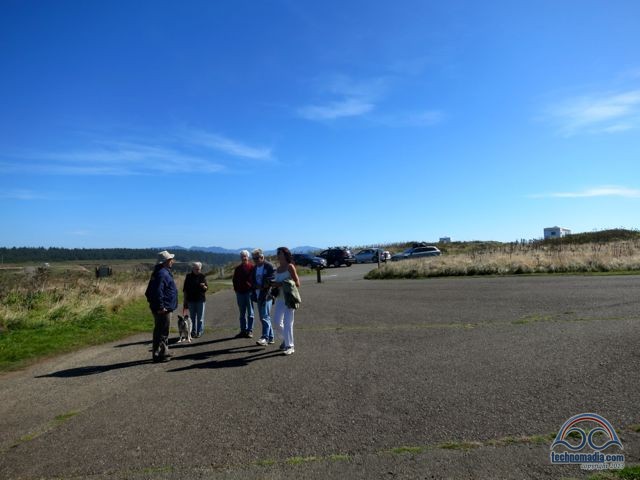
The Greeter meets visitors as they arrive, and lets them know about the availability of the tours and where to purchase the tickets – which cost just $2 per person, or free with a national or state park pass. Visitors who opt not to take the tour are still welcome to wander the grounds, they just can’t go up the tower to see the lens. The greeter also carries a counter and is responsible for keeping track of how many visitors stepped foot onto the grounds.
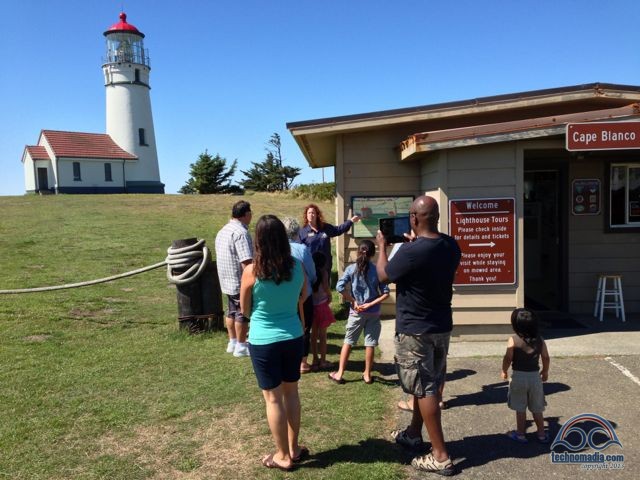
The Storyteller starts the tour by sharing a bit about what life was like for our valiant lighthouse keepers who lived onsite in the late 1800s before there were roads, electricity, running water or communications. The story is focused on James Langlois and his family, who served as lighthouse keeper of Cape Blanco from 1876 – 1919 – a total of a record breaking 42 years. Once the story telling is done, the visitors are directed to the lighthouse for the next stop on the tour.
If it’s a heavy visitor day, which September generally isn’t, there is some crowd management involved of making sure no more than 20 people are sent up at a time – which is coordinated by a pair of walkie-talkies between the buildings.
The couple serving this shift are also responsible for checking local weather conditions and posting them inside the greeting center. This includes checking the anemometer to get the current wind speed and direction, noting the tides and recording temperature. If the windspeeds exceed 50 mph (which apparently happens often enough), we are supposed to close the lighthouse for tours.
There is a gift shop inside the greeting center with a paid or volunteer staff member who runs the shop. Host volunteers (ie. us) are not responsible for running the cash register, selling tickets or stocking the shop. We just give tours and greet people.
As I’m more introverted and not as comfortable approaching people, Chris is usually the Greeter and I’m the Storyteller (they approach me, which I’m totally good with.). However it is very easy to swap places to keep things interesting, or cover for bathroom breaks.
Lighthouse Shifts
The two jobs at the Lighthouse are the Workroom and the Tower.
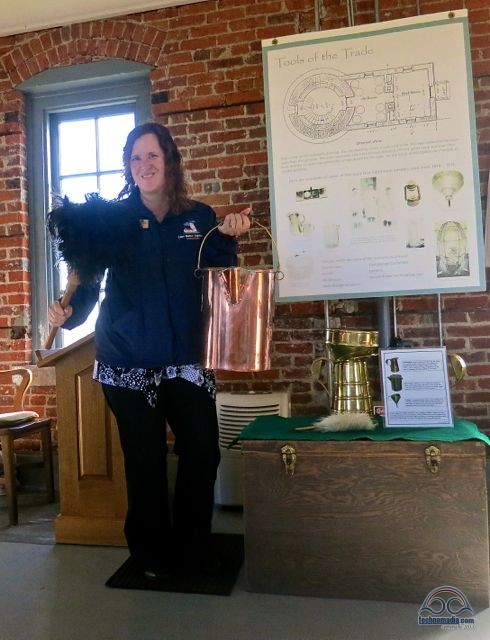
The Workroom Host is the first stop in the lighthouse on the lower level. The volunteer hosting in this room tells the story of how the light keepers started their evening here before sunset getting the oil and other supplies ready, and how they ended their shift by cleaning the lens. There are replicas of some of the items used, which can be used as props to help tell the story. The workroom host then coordinates with their partner up in the lantern for crowd management via walkie-talkie, as there’s not room for more than about 15-20 people at the top. When the all clear is given, the workroom host sends the visitors up the steps to wait in the watchroom just below the lantern. If there’s a backup, or a very interested visitor, we’re ready with additional information and stories to tell.
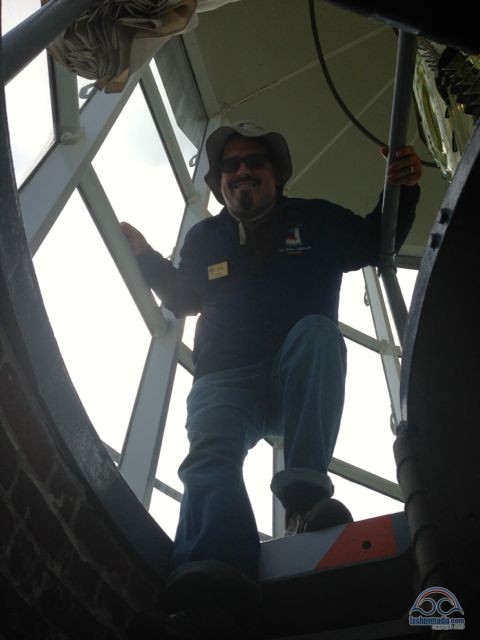
The Tower Host will usher their current visitors down the ladder and then greets the next waiting group in the watch room. The volunteer shares about the features of the watch room, and then takes 5 people at a time up the ladder into the lantern room. It’s always fun to see what captures the visitor’s interest first – the amazing lens or the amazing coastal view. Providing the visitors aren’t completely awe-struck, the host can then share about the details of the lens and the various evolutions the lighthouse has undergone as technology evolved. If it’s a slow day, visitors can linger in the room for a bit – but if there’s tours waiting, we’re technically supposed to limit the time in the lantern room to 3 minutes per tour. The lantern host typically only needs to climb the 64-steps once per shift, and goes up and down the final ladder into the lantern room once per tour.
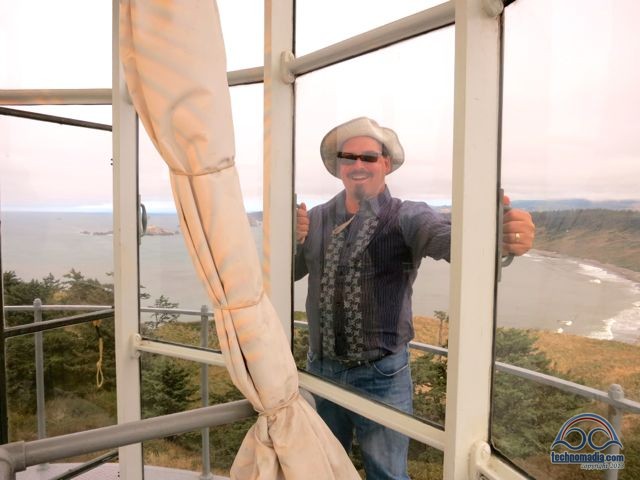
One of the perks of serving as the lantern host, is that you have permission to go outside the glass door in between tours and enjoy the breeze and views (visitors however are not allowed.)
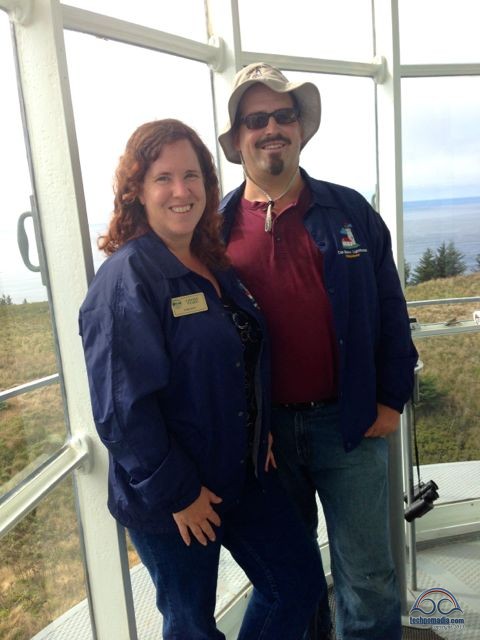
We seem to have found a pattern of me taking the workroom position and Chris the lantern. As marvelous as the view is, it actually gets rather warm and stuffy with the lantern, as the room is effectively a greenhouse with the heat of a 1000w bulb trapped inside with the sun beating down on the glass surrounded room. Combine that with a slightly trapped feeling of visitors blocking the exit to the ladder entrance, I’m more than happy to be in a shaded, larger, drafty cool room below (which still has amazing coastal views out the windows).
But on a slower days, I usually have time to run up the stairs a couple times, enjoy the view and smooch on Chris. *grin*
The Benefits
This is a volunteer position, so there is no direct financial compensation. However, there are some pretty nifty perks – the Oregon Parks really honors its hosts and makes us feel well appreciated.
Here’s some of the benefits:
- A huge, beautiful private feeling full hook-up site with 50a power, water and sewer in an area set aside just for lighthouse hosts
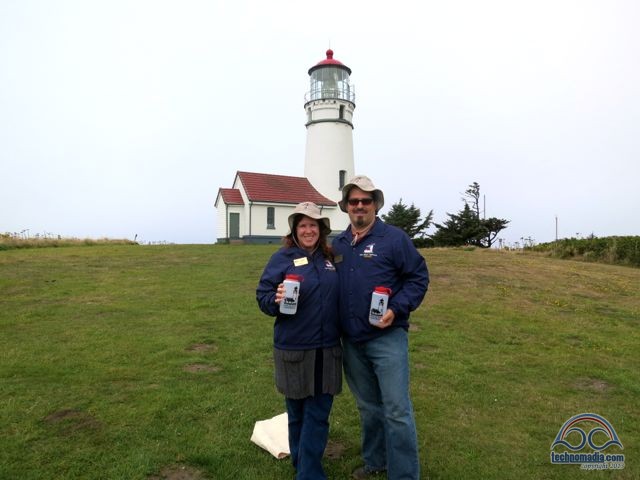
- A volunteer windbreaker jacket with the Cape Blanco lighthouse logo embroidered on it
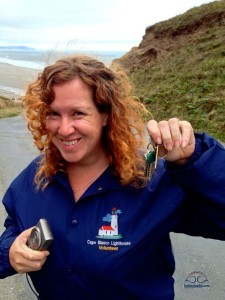
Hey Mom, they gave me the keys to a lighthouse!! - Your choice of Cape Blanco hats
- A Cape Blanco water bottle (needed, because there is no fresh water on the cape)
- An official Oregon State Park ‘Park Host’ name badge
- Name plate to hang at your site (gosh, I’m feeling all official like now – although Kiki is a bit miffed her name is not on the plaque)
- Oregon Park Day Use Pass good through the end of the year, with included 2-nights free in any state park on your way to your assignment, and 1-night when departing
- Volunteer injury insurance
- Best perk of all: Adding ‘lighthouse host’ to your life experience list
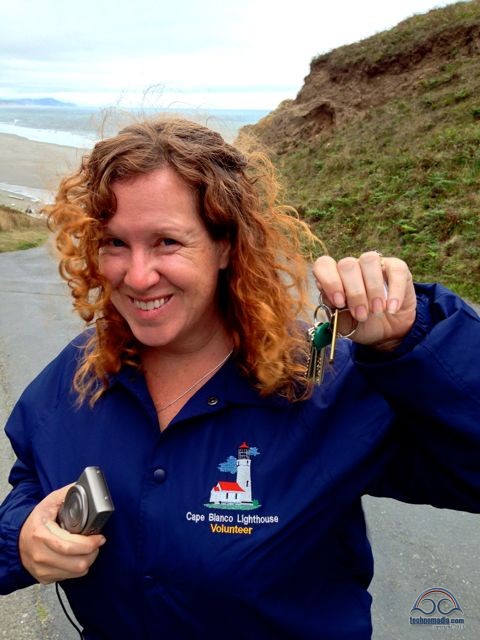
We get to keep all of the items, with the hope that we’ll serve again in the future and be able to re-use them (which does mean we’re expected to store them.)
And of course, there’s the thrill of volunteering and helping perpetuate this magical historical site by sharing it with park visitors. For many visitors, they’ve traveled a far way to see the lighthouse and it’s even potentially a bucketlist item for them.
You can’t help but be happy when sharing in that experience, and it’s brought us a lot of joy doing this ‘job’. It hardly feels like work at all.
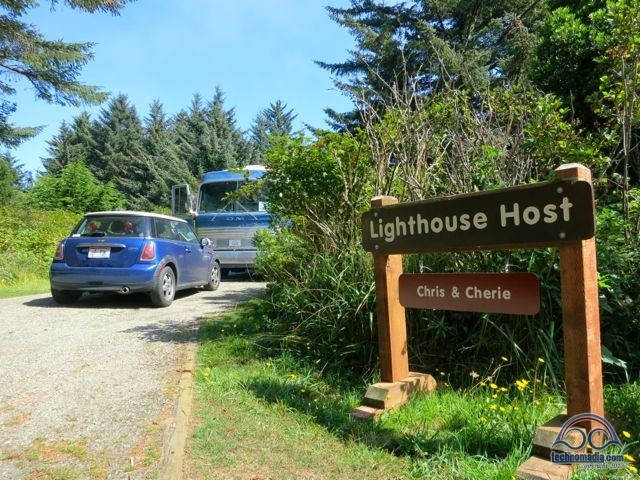
At a going rate of $24/night for an Oregon State Park full hook-up site, you’re essentially saving about $720 by not paying for a campsite for the month. Not that you could stay in one state park for more than 14 days without having a gig like this. And as the volunteer position requires you to live onsite, you don’t have to claim the savings as compensation on your taxes.
We’ll end up having served about 136 hours this month, which works out to an hourly rate of $5.30 for the value of the campsite – this is hardly a ‘pay the bills’ sort of gig. But it is nice perk to reduce the expenses for a month – both by not burning RV fuel and not paying campground fees. The experience itself, is invaluable.
And, let’s not forget – we’re living in a magical place right on the coast with access to hiking trails, amazing views and miles of beach. Living in one of the best state parks in the country – well let’s just say, it doesn’t suck. Not one bit.
Our only complaint we had was that the Verizon signal was an extremely poor 3G, but it’s been upgraded to LTE just **this week**. AT&T also recently turned on HSPA+ ‘4G’ service. Both signals are fairly marginal, so we are worshipping our various boosting gear to stabilize the signals.
So we get all the above perks, plus visitors continually THANKING us for volunteering? Yeah, it’s pretty awesome.
Lessons Learned
We are so incredibly happy with this gig, but there are a few things we wish we had realized before coming here that might be helpful to others contemplating signing up:
- Except for the workroom tour position, all of the shifts have us in sun exposure. I ended up with a slight sunburn after my first full day – I’ve since remembered to use my moisturizer with SPF.
-
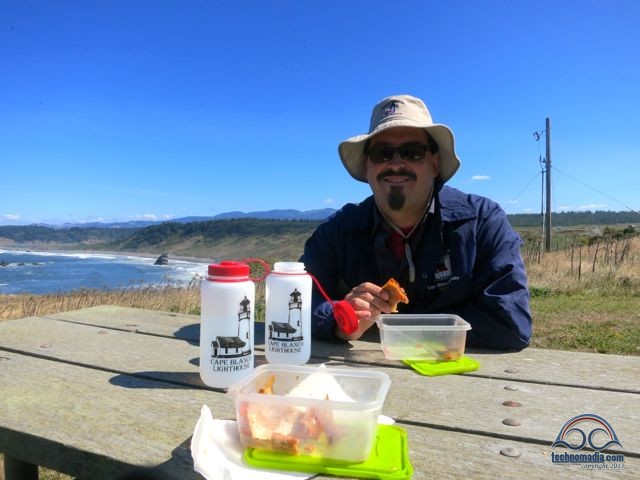
The lunchroom here is pretty snazzy. On the full days, it’s best to pack a lunch. There is only 30 minutes between the shift rotations, which doesn’t leave a lot of time to return to the campsite and grab a bite. We were caught off guard by this, and didn’t have too many easy options for packing a lunch onboard when we arrived.
- While there are general resources a few miles away in both Port Orford and Bandon, the grocery stores have a bit of a mark-up. Stocking up in a larger city before heading out this way turned out to be a great idea! There are several farmer’s market options nearby on days that might line-up with your time off.
- The weather at Cape Blanco can vary quite a bit, including foggy days, windy days, sunny days, wet days and cool days. Before heading out this way we did a thrift store run and picked up some weatherproof jackets, closed toe shoes that can get wet and a couple extra pairs of long pants to supplement our wardrobes. We’re very glad we did, as it’s definitely helped on the need to run into town to make use of the laundromat (Duds-n-Suds is actually a quite nice facility however.)
So, You Want to Be a Lighthouse Host?
Ok, if you’re sold on this gig – here’s how you get involved (we share this, knowing full well that this makes it more difficult for us to secure this gig in the future):
While Cape Blanco is managed by a combination of national BLM land, Curry County, a volunteer group, the state park system, local Indian tribes and the US Coast Guard – the interpretive host program is run by the Oregon State Park system. So simply proceed to the well developed Oregon State Park Volunteer Host webpage to learn more and fill out the application. You can check to see what volunteer host positions are open as well.
We initially heard about the openings at Cape Blanco from an open call that Nina put out on her blog at the request of the interpretive park ranger, and made a commitment directly with Greg Ryder. If you have specific interest in Cape Blanco, you can reach him at greg.ryder@state.or.us and he can give you more information. But you can also just fill out the application, and the park system will try to match you up with available positions.
The appointments are for 1-month at a time, which we find very approachable compared to other workamping commitments we’ve seen of up to 3-6 months.
The skill requirements are minimal – you need your own RV to stay in, you need to be available during normal tour hours including weekdays and weekends, you should be comfortable interacting with people and be able to re-tell lighthouse information to small groups. And, at least one of you needs to be able to climb 64 steps to the top of the lighthouse once a day. You do have an orientation on the first day to help you go over everything and you are given a script and background information to start your storytelling with.
As we’re both natural storytellers and are very comfortable speaking to groups, we both felt comfortable with the gig pretty instantaneously.
We initially signed up in late May to host for the month of July, but the engine breakdown caused us to have to cancel – Greg was extremely understanding. Once we knew we were mobile again, we contacted Greg in mid-August and serendipitously he still needed one host couple for September and was happy to welcome us. It was a perfect timing!
We are absolutely loving this gig, and we’re so thrilled we’ve had the opportunity to add ‘Lighthouse Host’ to our list. There are few experiences in our travels that merit worthy of repeating, and this is definitely one of them. We’ll be back.
Live Video Chat and Tour
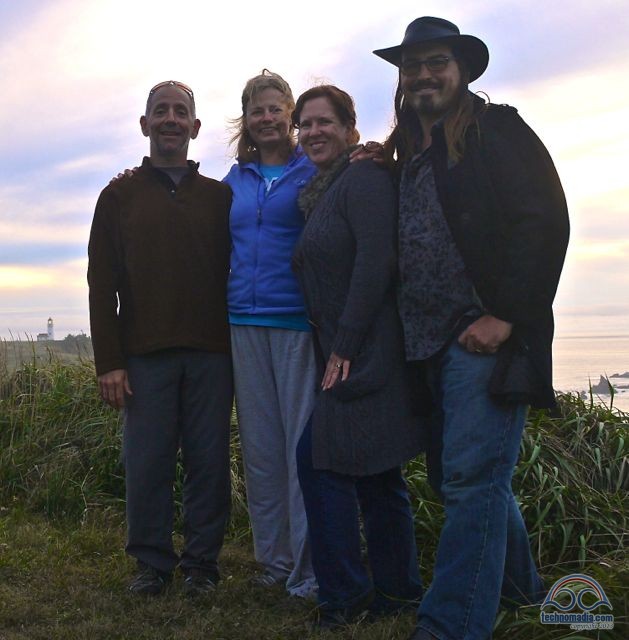
Join us and special guest stars – Nina & Paul of WheelingIt – for a video tour of Cape Blanco lighthouse, where the four of us have been volunteer hosts this month.
Want to see how this gig plays out in action? Or just want to learn more about Cape Blanco? Want to ‘meet’ Nina & Paul? Then this video is for you.
We live casted this video tour on UStream together, and then addressed viewer questions. Enjoy!
View archives of our past video chats
Sign up to get e-mail notifications when we schedule future video chats
thought you might be interested in my post re interpretive host training offered both by the National Association of Interpretation & Oregon Parks & Rec – we talked about this earlier when we met in Grayton Beach. hope this finds you both well. Gail
http://winecoastersblog.wordpress.com/2014/06/22/become-an-interpretive-host-impress-your-friends-neighbors-fellow-campers-with-your-knowledge-of-trivia/
Thanks for the information Gail! So far, none of the Oregon lighthouse hosting gigs have required this program and the spots have been pretty easy to get.
Thanks for summing up your experience. We had the good fortune to meet you and Chris and Nina and Paul at Cape Blanco and I can agree with you completely. It is a beautiful and magical place. We’ve gone on up the coast since we left, touring lighthouses. Had to duck over to Salem to get some maintenance work done, then back to the coast, after this rainy spell, to see Terrible Tilly then on to Washington.
As we’ve traveled, we tried to spend as many nights as we could in the Oregon State Parks. It has been great. The staff and volunteers in every park have been friendly, helpful and enthusiastic about what they are doing. I’m guessing that’s a sign of a good thing. Very tempting to become part of that by joining in the ranks of volunteers.
Happy travels as you go on from Cape Blanco. We’ll keep an eye out for your bus.
Larry and Alicia M.
Cape Blanco is very remote and beautiful. A month hosting there sounds like heaven to me, but some may not appreciate its challenges. You described it well.
I remember my visit there fondly and the hosts were great. While I do not (yet) have an RV, it is a great place to visit on the Oregon coast.
Just wanted to say that I reviewed your book The Mobile Internet Handbook on my blog and gave it 5 stars–it was an outstanding set of hints and tips and information on going mobile with the need for an Internet connection. I was utterly surprised to see that you’re in Oregon of late, as that’s where we live now, and are about to go mobile in a few weeks. Thanks for the book and the blog, tons of vital information in both.
Awww… thank you so much for the review, and so very glad the book is useful in your journey to the road!
Best wishes on your launch, and hopefully we’ll see you out there somewhere.
Loved hearing about your new adventure and how much fun it seems you are having! Thanks for sharing the information…
Thanks Scootingranny!
Thanks for taking the time to go into more depth about what you’re doing there. As someone who eschews crowds and cities and loves the more remote, the better, this looks like a lot of fun! About 15 years ago, I acted as a volunteer docent when a Grand Rapids, MI museum hosted a Dead Sea Scrolls exhibition. I loved it. I met a lot of interesting people and learned a lot. Volunteering always gives me more than I give to it. And the Fresnel lens! Priceless!!
Sounds like this would be an excellent fit for you.
Thank you so much for the very detailed description of your responsibilities. While we aren’t looking to work camp at this time, this sounds like fun and we can see the Oregon coast, too! We will be that way around September. We may just look into this.
This definitely isn’t like any workamping position we’ve heard of, so for someone looking to live in an amazing location for a minimal amount of volunteer service – highly recommended.