
We’ve made a few teaser posts showing off our new lithium ion battery bank, but we’ve yet to properly explain why on earth we decided to venture off into such uncharted electrical territory instead of installing a more traditional flooded lead acid or AGM battery bank.
This post is the start of a series explaining why we’ve gone down this path, and will focus on the chief downsides of the current default options most RV’ers choose. Which are:
Flooded Lead Acid – These are the most common batteries that you see in most stores, and are typically used for everything from “starter” (high current) batteries for engines to “deep cycle” (multiple deep discharges) powering golf carts and RV house systems. Flooded lead acid batteries are the cheapest per amp hour, but also have the most drawbacks.
AGM – Absorbed Glass Matt (and the similar Gel Cell) batteries are still chemically lead acid batteries, but the liquid acid has either been “gelled” or fully absorbed into a glass matt, giving them several advantages for RVers and boaters. They also typically cost quite a bit more.
What’s the upside of Lead Acid batteries?
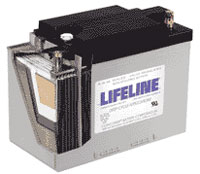
Lead acid chemistry batteries have been around since the dawn of the electric age, they are proven, and (when treated properly) extremely reliable. AGM variants in particular are well suited to RV use, with none of the flooded battery maintenance requirements, and somewhat less of the risks of damage from overcharging.
The best known brands like Lifeline and Trojan have a sterling reputation and rock solid warranties and support networks too.
In our opinion, AGM’s are a smart and solid choice for any RV. We went this route on our little Oliver Travel Trailer (designing in two 6 volt Lifeline AGM’s to create a 220 amp hour system), and we seriously considered building a massive 1300 amp hour AGM bank into our bus.
But yet, when we dived into researching the advantages of lithium and the downsides of lead acid batteries, the price premium for lithium batteries suddenly started to seem worthwhile. After much consideration, we decided that we were willing to risk the investment in an unproven technology for RV applications.
And besides… we like a new challenge and playing with bleeding edge technology!
The downsides of Lead Acid batteries
To understand why lithium batteries show such promise for an RV house battery bank, it first helps to understand all the ways that traditional lead acid batteries fall short.
Limited ”Useable” Capacity
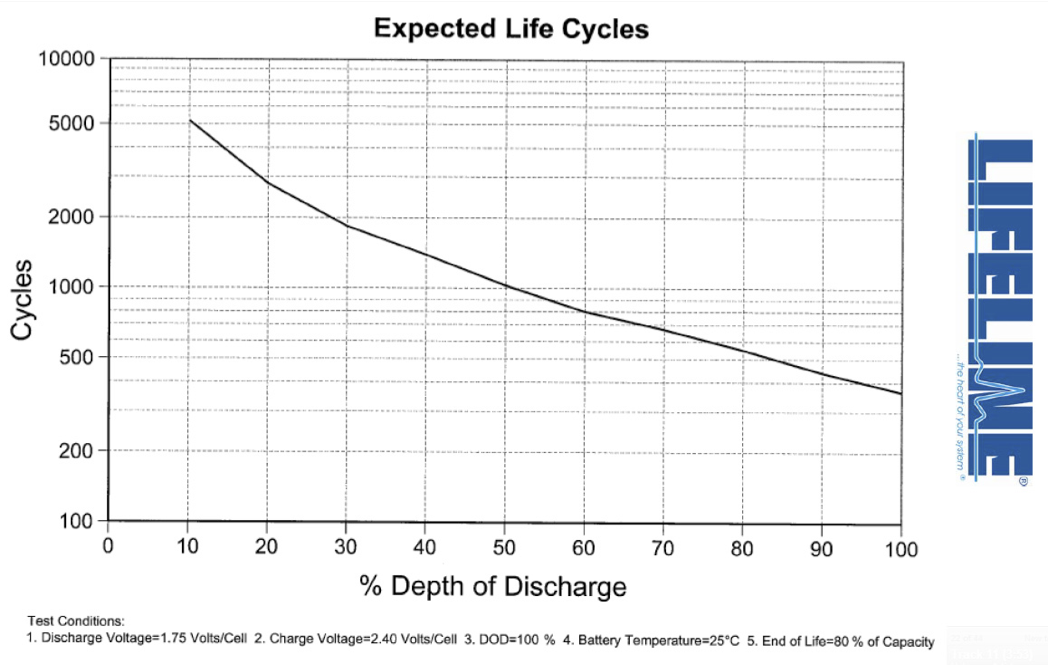
It is typically considered wise to use just 30% – 50% of the rated capacity of typical lead acid “Deep Cycle” batteries. This means that a 600 amp hour battery bank in practice only provides, at best, 300 amp hours of real capacity. If you even occasionally drain the batteries more than this their life will be drastically cut short.
Limited Cycle Life
Even if you are going easy on your batteries and are careful to never overly drain them, even the best deep cycle lead acid batteries are typically only good for 500-1000 cycles. If you are frequently tapping into your battery bank (such as a full-timing boondocker might), this could mean that your batteries may need replacement after less than 2 years use!
Slow & Inefficient Charging
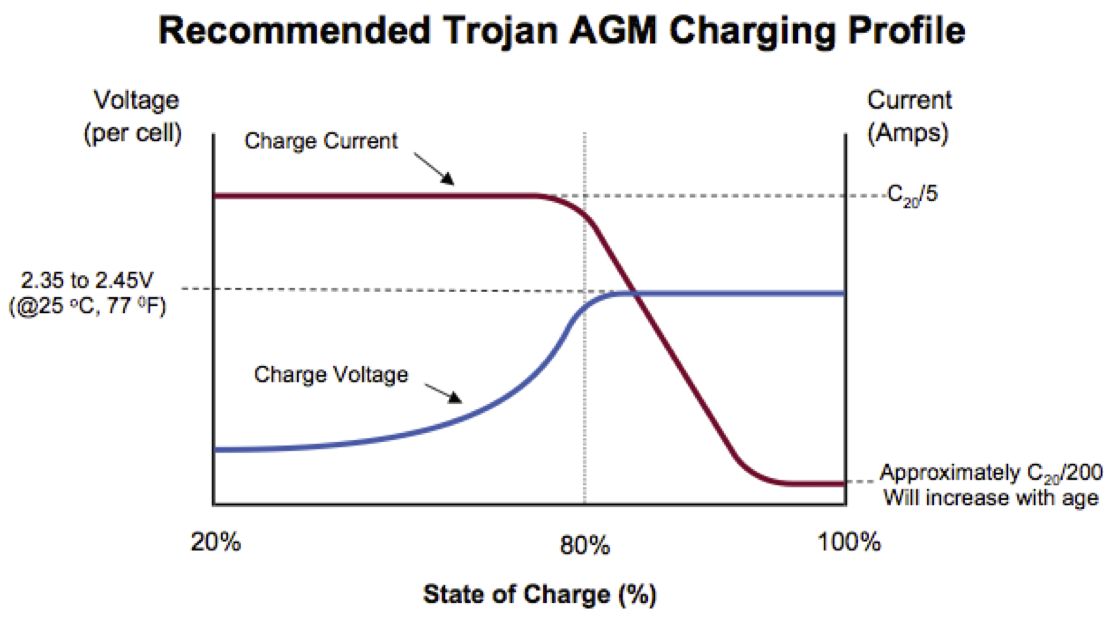
The final 20% of lead acid battery capacity can not be ”fast” charged. The first 80% can be “Bulk Charged” by a smart three-stage charger quickly (particularly AGM batteries can handle a high bulk charging current), but then the “Absorption” phase begins and the charging current drops off dramatically.
Just like a software development project, the final 20% of the work can end up taking 80% of the time.
This isn’t a big deal if you are charging plugged in overnight, but it is a huge issue if you have to leave your generator running for hours (which can be rather noisy and expensive to run). And if you are depending on solar and the sun sets before that final 20% has been topped off, you can easily end up with batteries that never actually get fully charged.
Not fully charging the final few percent would not be much of a problem in practice, if it wasn’t for the fact that a failure to regularly fully charge lead acid batteries prematurely ages them.
Smart battery dependent RV’ers need to strike a balance – some bulk charge to 80% daily, and once a week run the generator all day, or pull into a RV Park, to do a long “top off” charge. Others just buy the cheapest (typically Walmart or Costco) batteries they can find, and just replace them when they fail. Often they even try to get the replacement of their overly abused batteries covered under warranty!
Wasted Energy
In addition to all that wasted generator time, lead acid batteries suffer another efficiency issue – they waste as much as 15% of the energy put into them via inherent charging inefficiency. So if you provide 100 amps of power, you’ve only storing 85 amp hours.
This can be especially frustrating when charging via solar, when you are trying to squeeze as much efficiency out of every amp as possible before the sun goes down or gets covered up by clouds.
Placement Issues
Flooded lead acid batteries release noxious acidic gas while they are charging, and must be contained in a sealed battery box that is vented to the outside. They also must be stored upright, to avoid battery acid spills.
AGM batteries do not have these constraints, and can be placed in unventilated areas – even inside your living space. This is one of the reasons that AGM batteries have become so popular with sailors and RV’ers.
Maintenance Requirements
Flooded lead acid batteries must be periodically topped off with distilled water, which can be a cumbersome maintenance chore if your battery bays are difficult to get to.
AGM and gel cells though are truly maintenance free. Being maintenance free comes with a downside though – a flooded cell battery that is accidentally overcharged can often be salvaged by replacing the water that boiled off. A gel or AGM battery that is overcharged is often irreversibly destroyed.
Peukert’s Losses & Voltage Sag
A fully charged 12-volt lead acid battery starts off around 12.8 volts, but as it is drained the voltage drops steadily. The voltage drops below 12 volts when the battery still has 35% of its total capacity remaining, but some electronics may fail to operate with less than a full 12 volt supply. This “sag” effect can also lead to lights dimming.
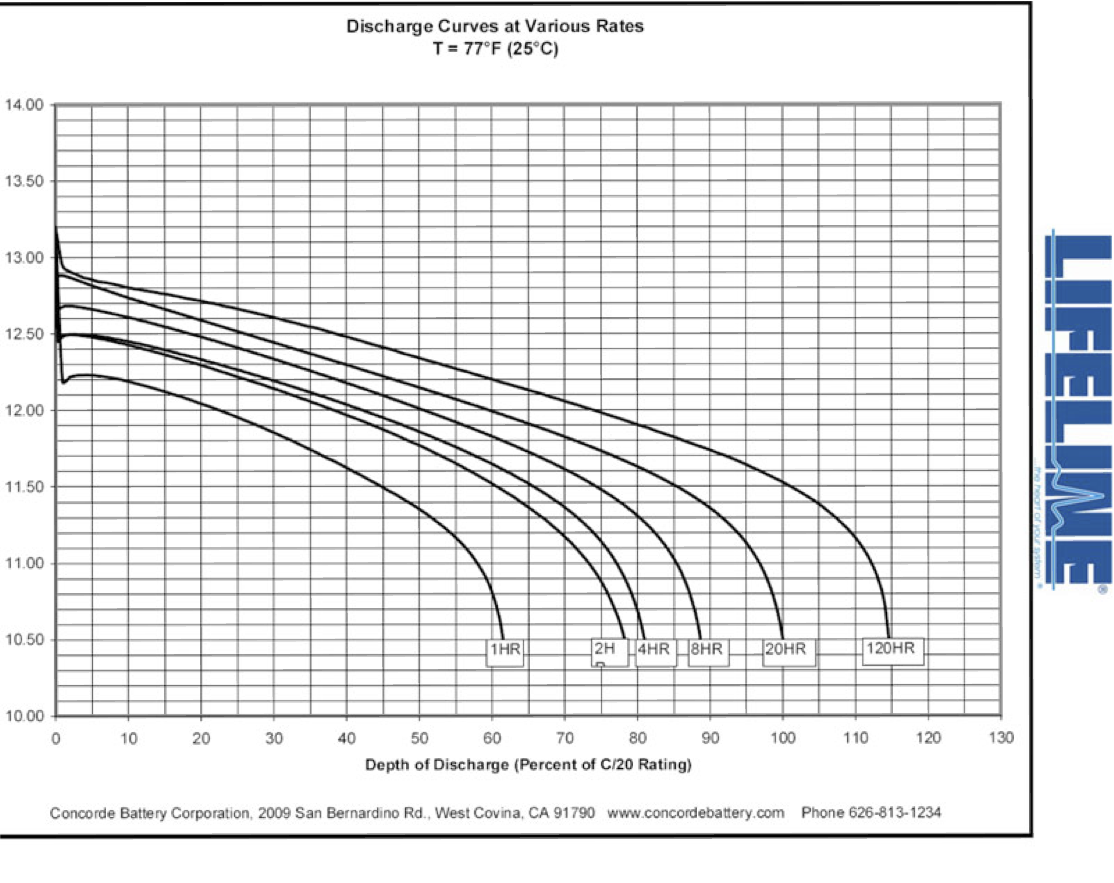
Also – the faster that you discharge a lead acid battery of any type, the less energy you can get out of it. This effect can be calculated by applying Peukert’s Law (named after German scientist W. Peukert), and in practice this means that high current loads like an air conditioner, a microwave or an induction cooktop can result in a lead acid battery bank being able to actually deliver as little as 60% of its normal capacity.
This is a huge loss in capacity when you need it most!
Size & Weight
And finally… Lead Acid Batteries are BIG & Really Heavy!!!
A typical 8D sized battery that is commonly used for large RV house banks is 20.5″ x 10.5″ x 9.5″. To pick a specific 8D example, Trojan’s 8D-AGM weighs 167lbs, and provides just 230 amp-hours of total capacity – which leaves you with 115 amp hours truly usable, and only 70 for a high discharge applications!
If you are designing for extensive boon docking, you will want at least four 8D’s, or as many as eight. That is a LOT of weight to be carting around that impacts your fuel economy.
And, if you have limited space for batteries on your rig – size alone of the batteries will limit your capacity. We first started researching lithium options when we were designing our Oliver’s electrical system, as we could only fit 220 amp hours of AGM golf cart batteries in our relatively small battery chamber.
As you can see, lead acid batteries come with some significant downsides. In my next post, I’ll explain the technical advantages of Lithium that lured us away from the tried and true lead acid path, and then I’ll follow up with a post about the cost factors we weighed.
By the way, we should note – we are not trying to motivate anyone to follow us on this path. We are not selling these batteries, we are not affiliates with any battery dealer, we paid for all our components and nor do we have any financial stake in the technology beyond our own systems. We are simply full time RVing technomads who are designing our own cutting edge home & office on wheels, and are sharing our research & project. Of course we’d love to have more folks out there pioneering and helping us take the arrows in our backs. Right now, we do not consider this technology ready for the mainstream, and those contemplating this technology need to be a bit savvy with electrical and battery technology.
Other Posts In this Series:
Promise of Lithium #2: Lithium Ion Battery Advantages
Promise of Lithium #3: Lithium RV Battery System Cost Analysis
A Year on Lithium (The One Year Follow-Up)
All our Lithium Ion Battery Posts

I’m just getting in to solar power and really don’t know very much, your videos are a great help in learning, I just wanted to say Ty.
This helped clarify. My partner and I are upgrading from tent camping where I made a portable solar charger with battery. Old school. Now that we’re researching RVs and want to still have power while off grid, your article reallt helped for knwoung what’s out in the RV world versus other industries that are bleeding edge on batteries. Thx Chris!
May I correct a couple of points:
1. Charge efficiency…AGM’s are far more efficient to recharge than a flooded battery. It typically only takes 1%-2% more power than removed to reach 100% SoC. This is a huge benefit over flooded batteries especially with the limited resource of sun-hours per day.
2. Overcharge GEL and AGM…GEL batteries are extremely sensitive to over voltage where AGM’s can tolerate it fairly well. Time at absorb voltage is the issue for both. If kept at the absorption voltage (temperature corrected) for too long a time, excess heat will build up and can lead to thermal runaway. This is because there is no more recombination (H2 & O2) taking place that requires the energy. Typically when the battery reaches 0.2% per 100AH capacity, you need to lower the voltage to stop the process. One of my customers melted down the case of of an AGM battery after he changed some charge control settings.
3. ”Useable” Capacity…”If you even occasionally drain the batteries more than this their life will be drastically cut short.” Each cycle of the battery reduces life cycles. The total life cycles are adjusted downward with each cycle which varies with depth of cycle (DoD). Occasionally deep cycling a battery, even to 80% DoD, will not drastically cut short battery life. The deeper each cycle is, the fewer remain cycles.
Larry
Starlight Solar Power Systems
Hi Larry –
Thanks for chiming in with some great comments.
As you point out – AGM’s have a ton of great advantages over both flooded lead and gel cells – in particular that they have a much higher charge efficiency than flooded cells, and a lower risk of damage due to overcharging than a gel.
If we hadn’t gone lithium, quality AGM’s would have been our next choice.
As for the impact of occasional deep discharges on lead batteries – I have in the past seen lab results and white papers that showed even a few occasional deep discharges having a pretty severe impact on overall lead battery life, but I don’t have any links handy to share.
If you’ve run across any resources that better illustrate the impact of deep discharges on battery life, I’d love to see them.
Thanks for chiming in!
– Chris
By the way Chris,
No wish to stray off topic but my (easily)modified Fridge and modified freezer are pulling very low amounts of power now. for both together during non sunshine (battery) hours (16 to keep it easy) Energy Star figures show they should pull 1Kw combined, mine in fact are pulling 340 watts total (240W freezer + 100W fridge) during this 16 hours. Perhaps I should write up a “How to” post ?? I have several other mods too.
PS. I also need to paint the name of the company on the side (Sir Sparks Electrical-Disaster Relief Command Vehicle) so hopefully I will never get hit for parking fees. LOL!
I am near Plant City. My self-converted box truck is not ready to roll yet (I need to get a tag LOL).
I recently moved in so will need to find my camera software (new computer) to send pics. but basically;
I bought a 2002 box truck from GA. (having had enough of the rat race and my ex’s BS so gave up my 7 acres to her). I then fitted it out as a self sustained “Man Cave” from which I run my office too. Living wise it is finished now but I have a few mechanical jobs still to do and a paint job.
In Tampa there is a place that sells heavy gauge aluminum angle very cheaply, it is this I used to make the collapsible solar panel frame. Just nuts and bolts NO welding. It is adjustable to the four seasons insolation inclination or flat against the truck side within a couple of minutes although it does need two people.
Feel free to come visit or wait til I find my software.
If you do go with PV panels consider a collapsible awning/rigid sunshade. After I filled my (smallish) roof with 1020 watts of PV I built an awning/sunshade that collapses in a few minutes, this gave me an extra 520 watts and a place to escape the sun/rain. Now with almost 1600 watts I can run a small AC unit as well.
Sir Sparks – your solar sunshade sounds absolutely awesome! I’d love to learn more about how you built it. Do you have any pictures or details posted anywhere?
Checking your website, it seems like you might be nearby too. Want to get together and compare notes? 🙂
Great article, Chris. Thanks.
Can’t wait for the next episode. Here with 3 x 130W panels, 6 x 6 golf cart batteries (4th year! Gone soon!), Solar Boost 2000E, TM 2025RV and… 1500W inverter (what a waste on that power line!!!). I saw 240W panels at Costco for a bit under $400!!! One of mine, the one that sits on the ground is shattered like a car windshield! (my fault… wind…). But still draws. Just have to unhook it when it rains!
Anyhow… thanks for all.
Ara & Spirit
One of the typically unpublished upsides of conventional, lead acid batteries is that the whole “recycling” cycle is not only complete, but mandated.
Lead acid batteries are one of the most recycled products sold in the US, according to a number of studies, (probably because it is so heavily, and economically, enforced….)
I’ll follow your thread with interest. I’d certainly prefer to have lighter batteries with longer life…
An excellent point Sherry!
Lithium batteries in theory are much more environmentally responsible than NiCad batteries, and should ultimately prove to be recyclable. But the infrastructure for recycling lead acid batteries is fully in place today, and this is indeed an advantage — particularly for people who abuse their batteries and replace them every year.
Since I’m considering replacing the pair of less than a year old golf cart batteries in my RV with a set of 4 AGMs (need a bigger battery tray), I’d like to see your writeup of the lithium batteries. I may do my solar install first, but then it would be oversized for the batteries.
Just a detail note: I think AGM stands for “absorbed glass mat” and not “applied glass matt.”
Looking forward to the next installment. I’m especially interested to compare the new batteries for solar (without access to generators/hookups) (not your only mission, I realize).
Thanks for posting.
Pen
Thanks a bunch for catching that, Pen!
As doing a solar install on the bus is our next major project, we definitely have lots to share about why we think lithium is an ideal pairing with solar.
What a tease….what a tease! Here I was totally gripped by the Lithium in the title and missing the fact it was about lead acid downsides….hehehe….still, this is a wonderfully well-written article. Very good overview of the current “norm”.We went AGM on our coach for exactly the reasons you wrote, but totally agree w/ all the downsides on cycle, weight and lifetimes.
Waiting with all excitement for the next issue 🙂
Nina
Great run down. Can’t wait for more!
I have never liked lead acid batteries owing to the weight they possess and their limited useable capacity. Apart from the above shortcomings, it contains hazardous substances so a lot of care must be taken during installation, removal, working around and disposal of lead acid batteries to avoid injury.